Custom Packaging Manufacturer in China | OEM & ODM Packaging Factory

Meta Description: Custom packaging manufacturer in China for rigid boxes, cosmetic, perfume, jewelry and gift packaging. OEM/ODM, sampling, QC and bulk production.
Custom Packaging Manufacturer in China for Brands That Need More Than a Box
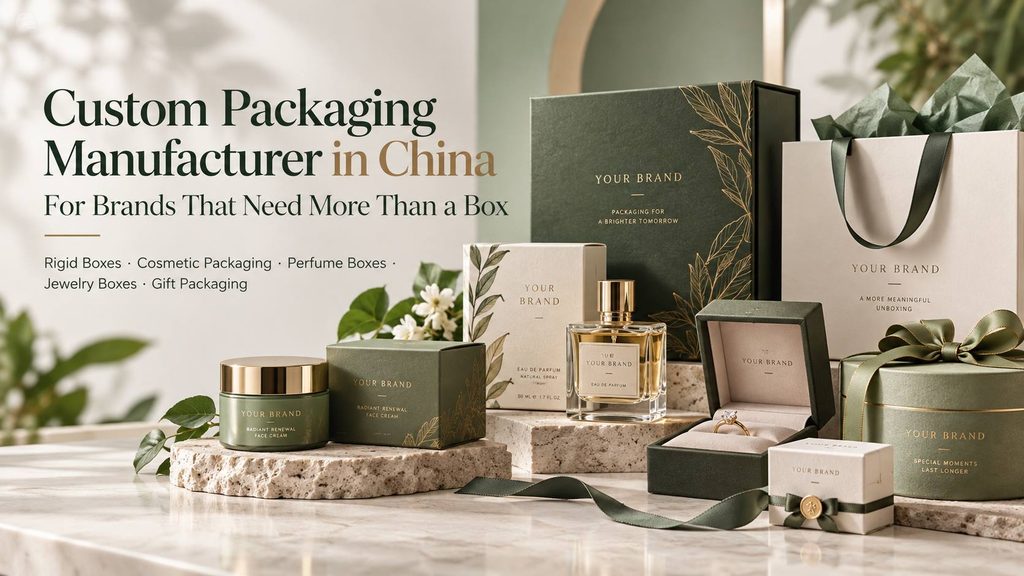
Choosing a custom packaging manufacturer is not simply about finding a factory that can print your logo.
The real challenge is finding a supplier that can understand your product, translate a design into a practical box structure, select the right materials, develop a reliable sample, control finishing quality, and reproduce the approved result consistently during mass production.
This matters even more when packaging is part of the product experience.
A perfume bottle needs to remain secure inside its insert. A jewelry box has to protect delicate products while creating a premium presentation. A cosmetic collection may require several SKUs to share the same visual system. A luxury gift box may combine specialty paper, foil stamping, embossing, inserts, and custom accessories within one structure.
For these projects, packaging is not only a printed container. It is a combination of structure, materials, engineering, production control, and brand presentation.
LVPACK supports international brands, designers, ecommerce businesses, sourcing companies, and growing companies with custom packaging development and manufacturing. Projects can begin from a reference image, an existing box, finished artwork, product dimensions, or an early packaging idea.
The goal is straightforward: turn the concept into packaging that can be sampled, manufactured, inspected, shipped, and reordered reliably.
Can a Custom Packaging Manufacturer in China Turn Your Design Into a Production-Ready Box?
A capable custom packaging manufacturer in China should be able to evaluate whether a packaging design can be produced reliably before mass production starts. This includes checking structure, dimensions, materials, inserts, printing, finishing, assembly, production tolerances, and cost. A good design must not only look attractive; it should also protect the product, work efficiently in production, and remain consistent when thousands of units are manufactured.
A packaging concept can look perfect on a screen and still create problems once it reaches the factory.
A magnetic box may look elegant in a rendering but become too bulky when thicker greyboard is added. A glass perfume bottle may appear secure in a digital mockup but move inside the insert during transportation. A detailed foil logo may look sharp in artwork yet lose definition when applied to heavily textured paper.
That is why packaging development should begin with one practical question:
Can this design be manufactured reliably at the required quality, quantity, budget, and timeline?
Projects can start from:
- A reference packaging image
- A finished artwork file
- A rough sketch
- Product dimensions
- Existing packaging that needs improvement
- Brand guidelines
- A general packaging concept
For brands developing custom packaging boxes, the first stage is not choosing decorative finishes. It is understanding what the packaging needs to achieve.
The structure should be built around the product rather than forcing the product into an unsuitable standard box.
A 30 ml perfume bottle, a multi-piece skincare gift set, and a jewelry collection all have different requirements for product protection, presentation, opening experience, and internal support.
Important considerations include:
- Product dimensions and weight
- Protection requirements
- Retail, ecommerce, gifting, or shipping use
- Product orientation
- Opening experience
- Reusability
- Assembly efficiency
- Shipping volume
- Order quantity
Common structures include:
- magnetic rigid boxes
- drawer boxes
- lid and base boxes
- Book-style boxes
- Double-door boxes
- Collapsible rigid boxes
- Display boxes
- Multi-layer gift boxes
- Custom-shaped boxes
For premium beauty, fragrance, jewelry, and gift products, custom rigid boxes are often selected when both presentation and structural strength matter.
The best packaging structure should balance product protection, brand presentation, and production efficiency.
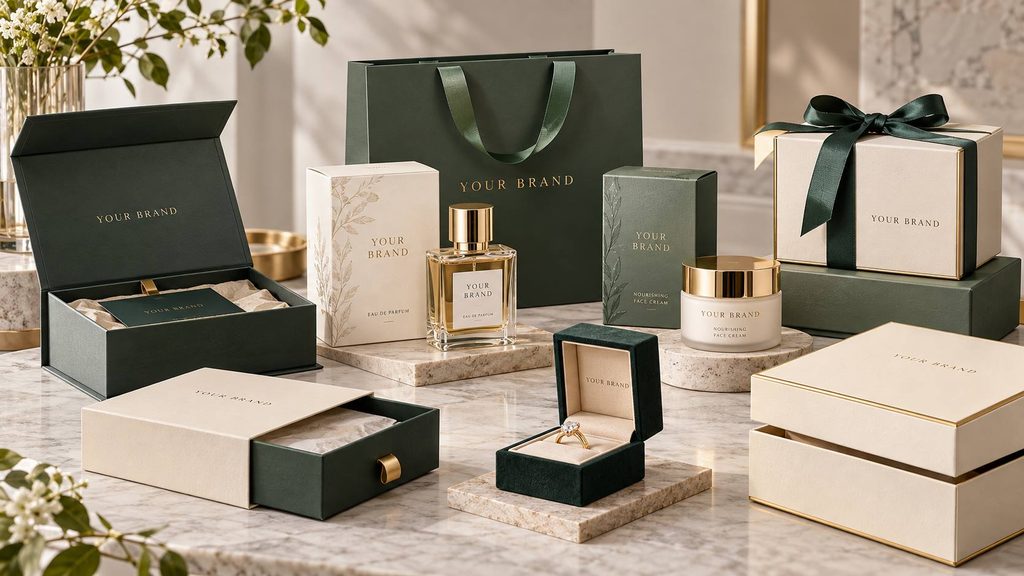
What Types of Custom Packaging Boxes Can We Manufacture?
LVPACK supports a wide range of custom paper packaging projects, with particular experience in premium rigid packaging, beauty packaging, fragrance packaging, jewelry presentation boxes, gift packaging, and brand-led packaging systems.
The most suitable structure depends on what the product is, how it will be sold, and what the customer expects from the unboxing experience.
Luxury Rigid Packaging
Rigid boxes are often selected for products where packaging is expected to feel substantial and premium.
- Magnetic closure boxes
- Drawer boxes
- Book-style boxes
- Lid-and-base boxes
- Double-door boxes
- Multi-layer boxes
- Collapsible rigid boxes
- Presentation boxes
These structures are commonly used for cosmetics, perfume, jewelry, watches, premium gifts, spirits, candles, and product sets.
Beauty and Personal Care Packaging
For cosmetic packaging, the structure often needs to balance visual presentation with SKU management, inserts, color consistency, and retail display requirements.
- Skincare boxes
- Cosmetic gift sets
- Makeup packaging
- Serum boxes
- Beauty presentation boxes
- Product collection boxes
For brands with several products, packaging can also be developed as a coordinated family rather than as isolated boxes.
Fragrance Packaging
For perfume boxes, the outer box and inner support must work together.
- Accurate internal dimensions
- Secure inserts
- Stable bottle positioning
- Protection during transport
- Controlled opening experience
Premium fragrance packaging may also use specialty paper, foil stamping, embossing, soft-touch surfaces, or custom accessories.
Jewelry and Watch Packaging
For jewelry boxes, presentation and product protection are equally important.
- Ring slots
- Necklace positioning
- Earring support
- Watch cushions
- Velvet or flocked interiors
- Compact premium structures
The box should protect the product while keeping it positioned correctly when the customer opens the package.
Gift and Lifestyle Packaging
- Candle boxes
- Flower boxes
- Corporate gift packaging
- Food gift boxes
- Seasonal packaging
- Limited-edition boxes
- Brand collaboration packaging
The most effective structure is not necessarily the most complicated one. It is the one that performs well for the product, target market, budget, and supply chain.
How Far Can a Custom Packaging Factory Customize Your Box?
A custom packaging project can be developed across much more than size and logo placement.
A professional custom packaging factory should be able to adjust the structure, materials, colors, finishing, inserts, opening method, and branded details so the final packaging fits both the product and the brand.
| Customization Area | Available Options |
| Size | Custom internal and external dimensions |
| Structure | Magnetic, drawer, lid-and-base, folding, display, custom shapes |
| Material | Greyboard, coated paper, kraft, specialty paper, recycled paper |
| Color | CMYK, Pantone, spot color, metallic effects |
| Logo | Printing, foil, embossing, debossing, UV |
| Insert | Paper, EVA, foam, velvet, flocked, PET, molded pulp |
| Surface | Matte, soft-touch, gloss, texture finishes |
| Accessories | Ribbon, handles, magnets, tags, metal details |
| Opening | Flip-open, drawer, magnetic, double-door, folding |
| Brand Elements | Logo, pattern, messaging, cards, stickers |
Structure Customization
Structure determines how the package opens, protects the product, and presents the contents. A premium presentation box may need a magnetic closure. A product set may work better with a drawer structure. A large gift box may benefit from a collapsible structure to reduce shipping volume. A custom solution should reflect the real use of the product.
Color Customization
Brand color consistency is especially important for cosmetics, fragrance, fashion, and luxury products.
- CMYK
- Pantone spot colors
- Solid brand colors
- Metallic tones
- Gradient effects
Where exact brand color matters, the color should be reviewed on the actual production material whenever possible.
Insert Customization
For products that need support inside the box, custom inserts can be developed according to product dimensions and presentation requirements.
- Paperboard inserts
- EVA
- Foam
- Flocked inserts
- Velvet inserts
- PET trays
- Molded pulp
- Die-cut paper structures
The insert should protect the product without making removal difficult. It should also match the visual quality of the outer packaging.
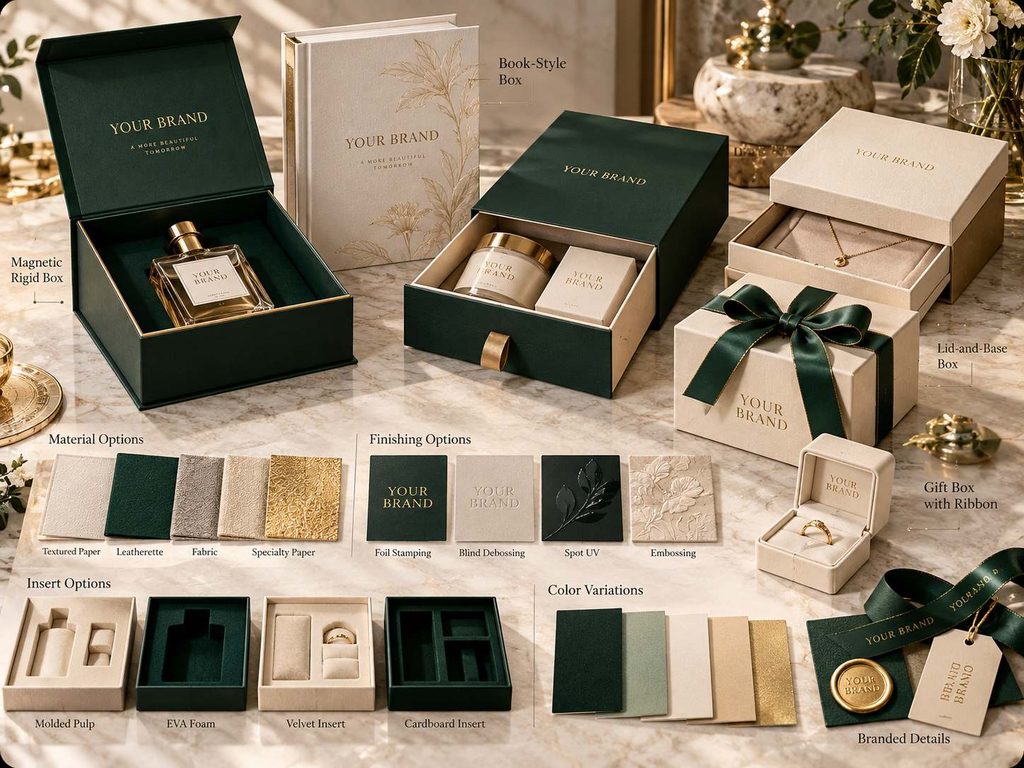
Which Materials and Finishing Options Are Best for Custom Luxury Packaging?
Materials and finishing should support the brand concept, not simply make the package more complicated. For custom luxury packaging, the strongest results often come from combining the right structure, material, and one or two carefully selected surface treatments rather than using every available process.
Packaging Materials
Common packaging materials include:
- Greyboard
- Art paper
- Ivory board
- Kraft paper
- Black card
- Specialty paper
- Embossed paper
- Recycled paper
- Corrugated board
- Leather-like paper
Material selection should consider appearance, protection, production performance, and budget.
| Packaging Requirement | Material Consideration |
| Lightweight cosmetic product | Moderate board thickness may be sufficient |
| Heavy glass bottle | Strong board and secure insert |
| Fine foil details | Smoother paper can improve reproduction |
| Natural brand image | Kraft or recycled paper may suit the concept |
| Premium tactile experience | Specialty or textured paper |
| Dark-color packaging | Foil, white ink, or screen printing may perform better |
A premium material is only useful if it works with the printing and finishing process.
Printing Options
- CMYK printing
- Pantone spot-color printing
- Digital printing
- Screen printing
- Offset printing
- Metallic ink
- White ink
- Custom graphic printing
Finishing Options
- foil stamping
- Gold foil
- Silver foil
- Rose-gold foil
- embossing
- Debossing
- Spot UV
- Matte lamination
- Soft-touch lamination
- Gloss lamination
- Texture finishing
- Scratch-resistant surface treatment
More finishing does not automatically mean more premium packaging. A clean combination such as soft-touch lamination with a gold foil logo may create a stronger result than placing foil, UV, embossing, metallic ink, and several textures on the same surface.
The finishing plan should support three goals:
- Clear brand recognition
- Stable production
- Controlled cost
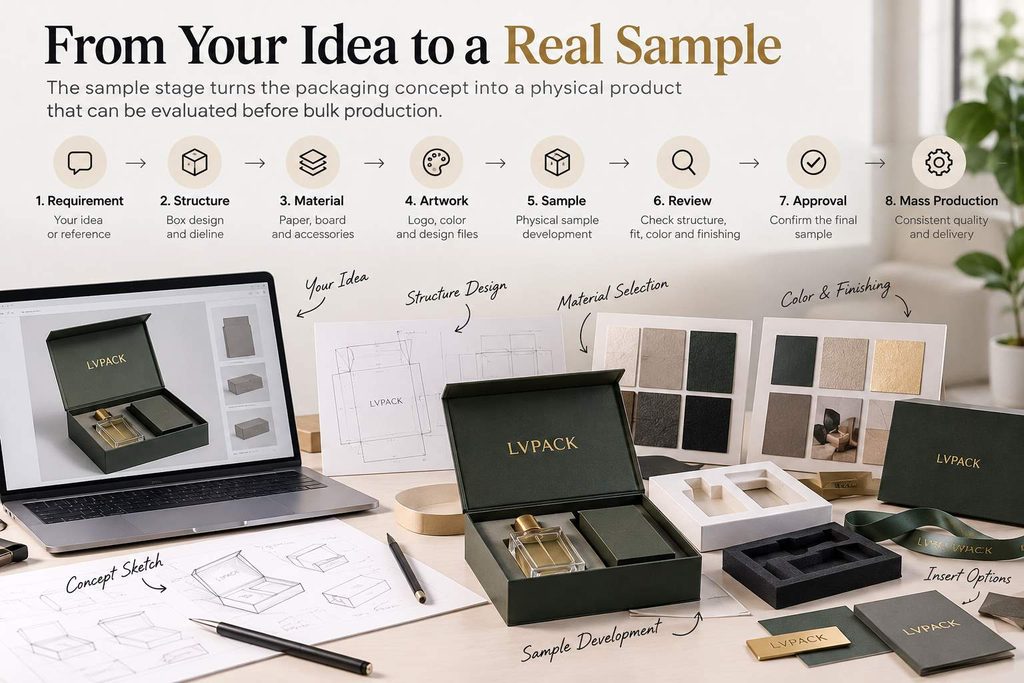
How Does a Custom Packaging Manufacturer Develop Samples From Your Idea?
The sample stage turns the packaging concept into a physical product that can be evaluated before bulk production.
A custom packaging project normally moves through a controlled sequence:
Requirement → Structure → Material → Artwork → Sample → Review → Approval → Mass Production
The sample should confirm more than appearance.
- Structure
- Dimensions
- Product fit
- Materials
- Colors
- Printing
- Finishing
- Insert fit
- Opening experience
- Assembly
What Can You Provide to Start?
- Product dimensions
- Product weight
- Reference images
- Artwork
- Logo
- Estimated quantity
- Preferred structure
- Material preference
- Desired finishing
- Insert requirements
- Target market
- Required delivery date
Not every detail needs to be finalized. When the customer does not yet know which structure or material to use, the project can begin from the product and intended packaging experience.
What Is Reviewed Before Sampling?
Before packaging sample development, important details should already be checked.
| Development Point | Why It Matters |
| Internal dimensions | Ensures correct product fit |
| Board thickness | Controls strength and proportions |
| Opening method | Affects usability |
| Insert tolerance | Prevents movement or excessive tightness |
| Paper selection | Influences printing and finishing |
| Logo dimensions | Affects foil and embossing accuracy |
| Structural folds | Influence durability |
| Assembly method | Influences production consistency |
| Shipping volume | Affects freight |
| Quantity | Influences production method |
Correcting these details before bulk production is significantly easier than correcting them after thousands of boxes have already been manufactured.
Why Is a Physical Sample Important?
Digital renderings can show the visual concept, but they cannot fully show:
- Paper texture
- Box stiffness
- Magnet strength
- Foil reflection
- Embossing depth
- Insert pressure
- Product fit
- Opening feel
For premium custom packaging, a physical sample provides a much stronger basis for approval.
How Do We Keep Custom Packaging Production Consistent With the Approved Sample?
A good sample proves that the packaging can be made once. Reliable manufacturing proves that the same result can be repeated across thousands of units.
The approved sample should therefore become the production reference for materials, dimensions, color, finishing, inserts, and assembly.
Consistency is especially important when a brand expects repeat orders.
Key Production Control Points
- Incoming material inspection
- Paper thickness
- Printing
- Color
- Surface finishing
- Die-cut dimensions
- Structural dimensions
- Box assembly
- Gluing
- Insert installation
- Final appearance
- Pre-shipment inspection
Sample-to-Bulk Consistency
During custom packaging production, the factory should compare mass-produced units against the agreed production standard.
- Box dimensions
- Paper specification
- Brand colors
- Foil position
- Embossing depth
- Logo alignment
- Insert size
- Opening and closing
- Surface appearance
Small differences can become highly visible when packaging is placed together in retail or used across the same product collection.
Why Repeatability Matters
- Repeat production
- New product launches
- Additional sizes
- Seasonal versions
- Updated artwork
- New gift sets
The more the brand grows, the more important production consistency becomes. A reliable packaging supplier should make future orders easier, not force the customer to restart the development process each time.
What Are the MOQ and Lead Time for Custom Packaging in China?
MOQ and production time depend on the structure, material, finishing, quantity, and project complexity. For LVPACK, the standard minimum order quantity is 1,000 pieces for custom packaging projects.
MOQ exists because custom packaging includes fixed production costs such as:
- Die-cutting tools
- Printing setup
- Foil plates
- Material preparation
- Color setup
- Machine setup
- Sample development
These costs are easier to absorb when spread across a larger production quantity.
MOQ
Standard MOQ: 1,000 pcs
The actual commercial arrangement may still depend on:
- Number of SKUs
- Packaging structure
- Material
- Printing
- Finishing
- Insert type
What Affects Lead Time?
- Structure complexity
- Material sourcing
- Printing method
- Surface finishing
- Custom inserts
- Sample revisions
- Order quantity
- Factory production schedule
- Peak season
A simple paper box and a complex rigid gift box should not be expected to have the same manufacturing timeline.
Plan From the Required Delivery Date
For international buyers, factory production time is only one part of the schedule.
- Structure development
- Sampling
- Sample shipping
- Customer approval
- Material preparation
- Mass production
- Inspection
- International freight
For a launch, seasonal collection, or promotional campaign, it is better to work backward from the required warehouse arrival date.
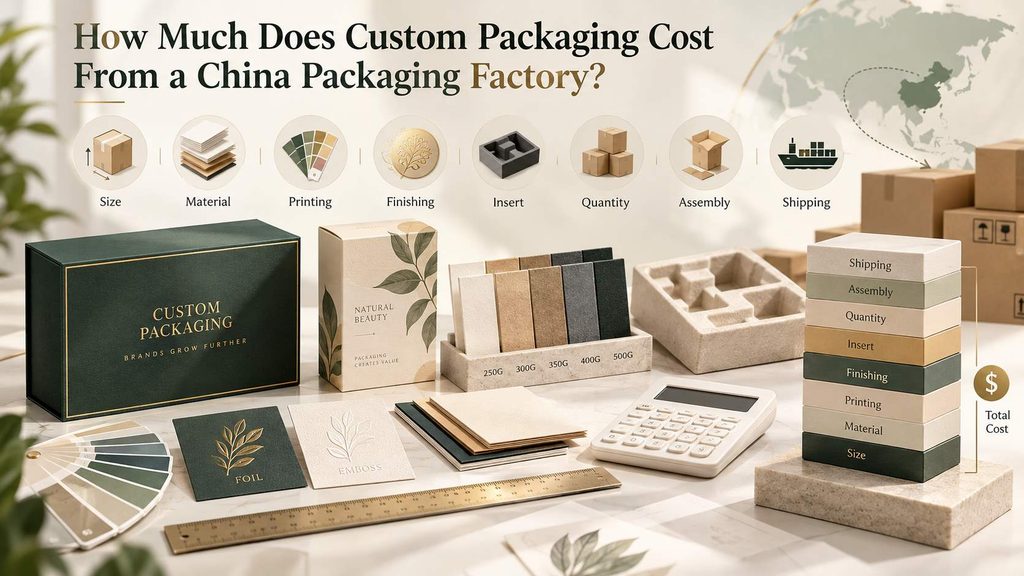
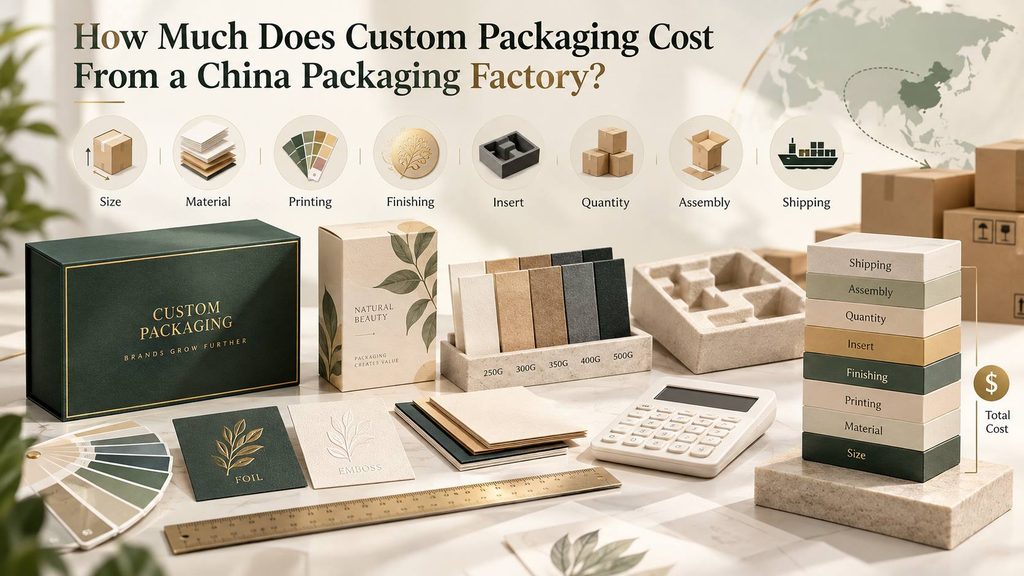
How Much Does Custom Packaging Cost From a China Packaging Factory?
Custom packaging does not have one standard price. Cost depends on the physical construction and production requirements of the box.
- Box dimensions
- Material
- Board thickness
- Printing
- Finishing
- Insert
- Accessories
- Quantity
- Assembly
- Packing
- Freight
Why Size Matters
A larger box requires more material and may increase:
- Paper consumption
- Greyboard consumption
- Production handling
- Master-carton size
- Shipping volume
A few centimeters can make a meaningful difference when multiplied across thousands of boxes.
Why Finishing Matters
Each additional process adds production steps.
- Foil requires tooling and setup
- Embossing requires plates
- Spot UV requires an additional process
- Specialty paper may cost more than standard coated paper
- Hand-applied accessories increase labor
Why Inserts Matter
Insert cost depends heavily on material and structure. Paper inserts, EVA, velvet, molded pulp, and PET all have different production and assembly requirements.
Why Quantity Matters
Custom packaging includes fixed setup costs. If a setup costs $500:
- 500 boxes = $1.00 setup cost per unit
- 1,000 boxes = $0.50 per unit
- 5,000 boxes = $0.10 per unit
This is one reason unit price usually decreases as order quantity increases.
How Can Packaging Cost Be Optimized?
- Reducing unnecessary box size
- Simplifying the structure
- Standardizing box dimensions across SKUs
- Using different sleeves with one shared box
- Replacing foam with engineered paper inserts
- Reducing unnecessary finishing
- Using one strong finishing process instead of several
- Choosing collapsible structures when freight volume is high
- Improving master-carton packing efficiency
Good cost control removes unnecessary expense without removing the elements customers value.
What Information Is Needed for an Accurate Quote?
- Box dimensions
- Product dimensions
- Quantity
- Structure
- Material
- Logo
- Artwork
- Printing
- Finishing
- Insert
- Accessories
- Shipping destination
The clearer the specification, the more useful the quotation will be.
What Should You Look for in an OEM or ODM Packaging Manufacturer?
An OEM or ODM packaging manufacturer should provide more than manufacturing capacity. It should be able to understand the stage of the project and provide the right level of support.
OEM Packaging
OEM is suitable when the customer already has:
- Finished artwork
- Dimensions
- Technical requirements
- Material specifications
- Brand standards
The factory then focuses on manufacturing according to the approved requirements.
ODM Packaging
ODM is more suitable when the customer needs support with:
- Structure development
- Material selection
- Box optimization
- Insert development
- Finishing recommendations
- Cost optimization
For brands without a complete production-ready packaging specification, OEM and ODM packaging support can reduce development time and unnecessary revisions.
What Makes a Packaging Supplier Suitable for Long-Term Cooperation?
- Repeat-order consistency
- Production planning
- Clear communication
- Quality control
- Material sourcing
- Problem solving
- Multiple-SKU support
- New product development
- Stable supply
The best long-term supplier is not always the one that gives the lowest first quotation. It is the supplier that makes future packaging projects easier to manage.
Why Do Brands Choose LVPACK as a Custom Packaging Manufacturer in China?
LVPACK combines packaging development, sampling, manufacturing, quality control, and supply-chain coordination within one packaging workflow.
The company was established in 2013 and currently operates with approximately:
| Capability | Current Team / Capacity |
| Total employees | 80 |
| QC team | 10 |
| Design and sample development | 8 |
| Core production staff | 50 |
| Printing and post-processing staff | 6 |
| Merchandisers / project coordinators | 6 |
| Packaging production lines | 5 |
| MOQ | 1,000 pcs |
The company supports customers from early packaging development through production and delivery.
Packaging Development
Projects can start from:
- Reference images
- Product dimensions
- Artwork
- Existing packaging
- Brand concepts
Development support can include:
- Structure
- Materials
- Inserts
- Finishing
- Cost considerations
- Production feasibility
One-Stop Packaging Support
Packaging often requires coordination across several processes.
- Paper sourcing
- Printing
- Die-cutting
- Surface finishing
- Inserts
- Accessories
- Assembly
- Inspection
- Logistics
Managing these processes through one packaging partner can reduce communication pressure for international buyers.
Quality Control
- Raw materials
- Printing
- Finishing
- Dimensions
- Assembly
- Inserts
- Finished products
Brand and Project Support
- Beauty brands
- Perfume brands
- Jewelry brands
- Ecommerce brands
- Designers
- Growing brands
- Packaging sourcing companies
- Gift businesses
- Private-label companies
The level of support can be adjusted according to the stage of the customer’s project.
Is Our Custom Packaging Factory the Right Fit for Your Brand?
LVPACK is particularly suitable for customers that need customized packaging rather than standard stock boxes.
It may be a good fit if you:
- Need a custom structure
- Need packaging developed from a reference image
- Require a custom insert
- Need premium paper and finishing
- Want to improve an existing box
- Need consistent repeat production
- Plan multiple product launches
- Need OEM or ODM support
- Want one supplier to coordinate several packaging processes
Typical applications include:
- Beauty
- Fragrance
- Jewelry
- Watches
- Candles
- Gifts
- Food gift sets
- Lifestyle products
- Premium retail products
It may be less suitable when:
- Your quantity is far below 1,000 pieces
- You only need a standard stock carton
- Price is the only purchasing factor
- You need a very small emergency order immediately
Clear project information makes it easier to determine whether the factory is the right fit before time is spent on sampling and quotation.
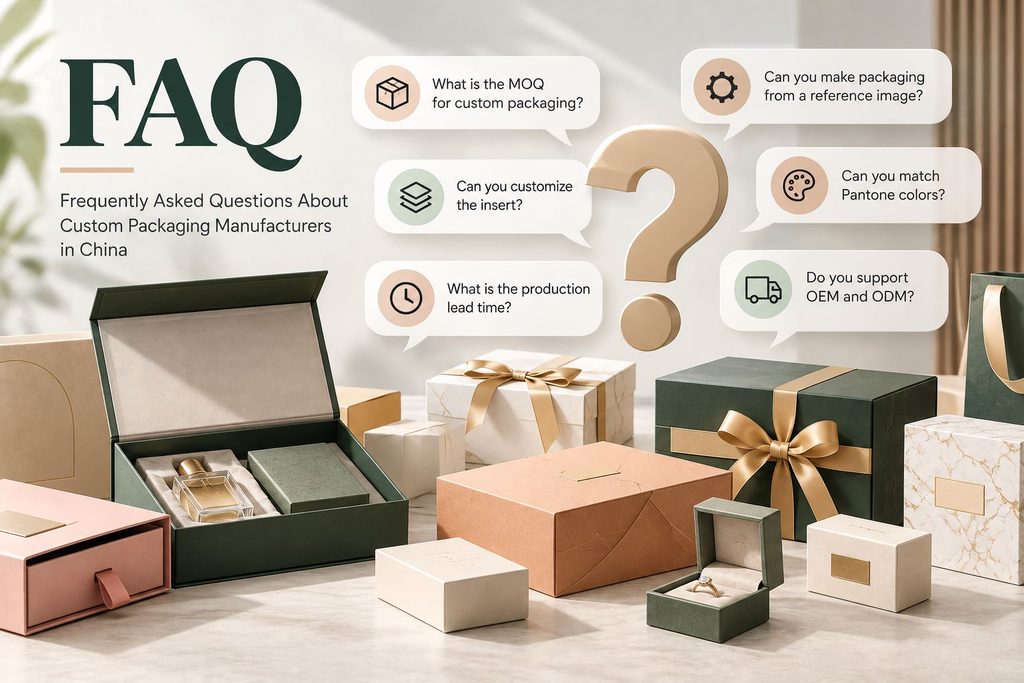
Frequently Asked Questions About Custom Packaging Manufacturers in China
What Is the MOQ for Custom Packaging?
LVPACK’s standard MOQ is 1,000 pieces. The final requirement can depend on structure, materials, finishing, inserts, and number of SKUs.
Can You Make Packaging From a Reference Image?
Yes. A project can begin from a reference image, sketch, product dimensions, or existing packaging. The structure can then be reviewed and adapted for manufacturing.
Can You Develop a Box if I Do Not Have a Dieline?
Yes. Structural development can be based on the product dimensions and desired packaging style.
Do You Provide Custom Packaging Samples?
Yes. Samples can be developed to confirm structure, dimensions, materials, printing, finishing, and insert fit before mass production.
Can You Match Pantone Colors?
Pantone spot colors can be used where accurate brand color control is required. Color performance should be reviewed according to the actual material and printing method.
Can You Customize the Insert?
Yes. custom inserts can be developed using paperboard, EVA, foam, flocking, velvet, PET, molded pulp, and other suitable materials.
Do You Support OEM and ODM Packaging?
Yes. OEM is suitable for customers with completed specifications. ODM support is available for customers who need structure, material, finishing, or cost-development assistance.
Can You Produce Complex Rigid Box Structures?
Yes. Structures can include magnetic boxes, drawer boxes, book-style boxes, double-door boxes, multi-layer boxes, collapsible boxes, and other custom formats.
How Do You Control Packaging Quality?
Quality control can include incoming-material inspection, printing checks, finishing inspection, dimensional checks, insert checks, assembly inspection, final random inspection, and pre-shipment inspection.
How Can I Get a Custom Packaging Quote?
Prepare as much of the following information as possible: product dimensions, box dimensions, quantity, reference images, artwork or logo, preferred structure, material, finishing, insert, required delivery date, and shipping destination. If some details are not yet finalized, they can be reviewed during the development stage.
Start Your Custom Packaging Project
Good packaging starts with more than a box style.
It starts with understanding the product, choosing a structure that works, selecting materials that support the design, engineering the insert correctly, and making sure the approved result can be repeated during mass production.
If you are developing custom packaging boxes, cosmetic packaging, perfume boxes, jewelry boxes, or custom rigid boxes, send us your product dimensions, reference image, artwork, estimated quantity, and target delivery date.
LVPACK can review the structure, materials, finishing, inserts, sampling requirements, and production feasibility before you move into mass production.
Start with the information you already have. The packaging can be developed from there.