Custom Calendar Box Manufacturer in China – Luxury Advent Calendar Packaging

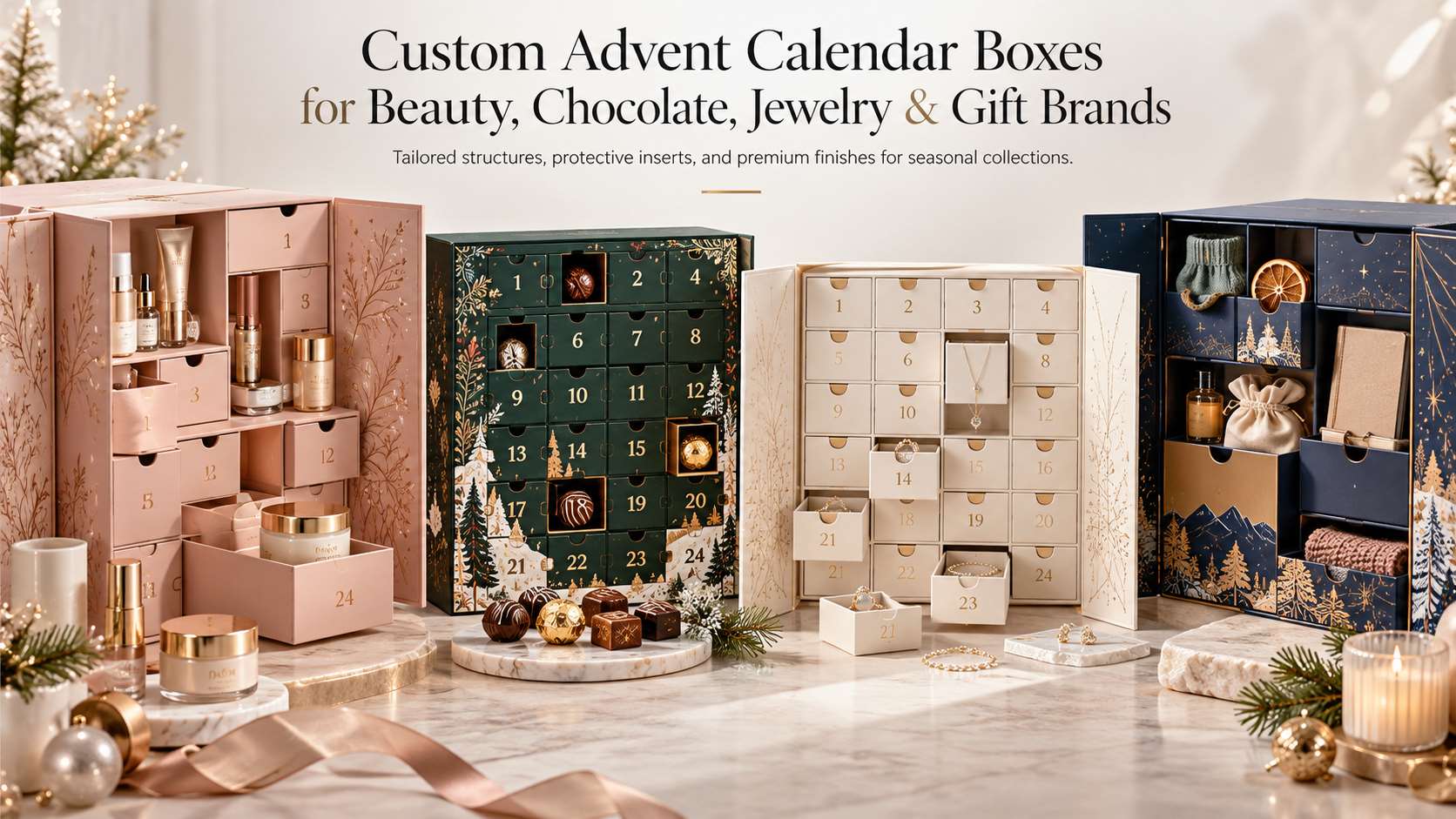
Custom calendar boxes bring multiple products together in one seasonal collection, but their success depends on much more than attractive Christmas artwork. Every compartment must fit its intended product, each opening should work smoothly, and the outer packaging must withstand filling, handling, and transportation.
LVPACK provides custom advent calendar packaging solutions for beauty, chocolate, jewelry, fragrance, and gift brands. Our packaging development services cover structural design, customized compartments, material selection, printing, decorative finishes, sampling, and bulk production.
From compact 12-day gift calendars to 24-day collections with individually fitted drawers, we help brands turn their product assortments into practical packaging designs. Whether you already have finished artwork or are exploring an initial concept, we can review your requirements and discuss a suitable manufacturing approach.
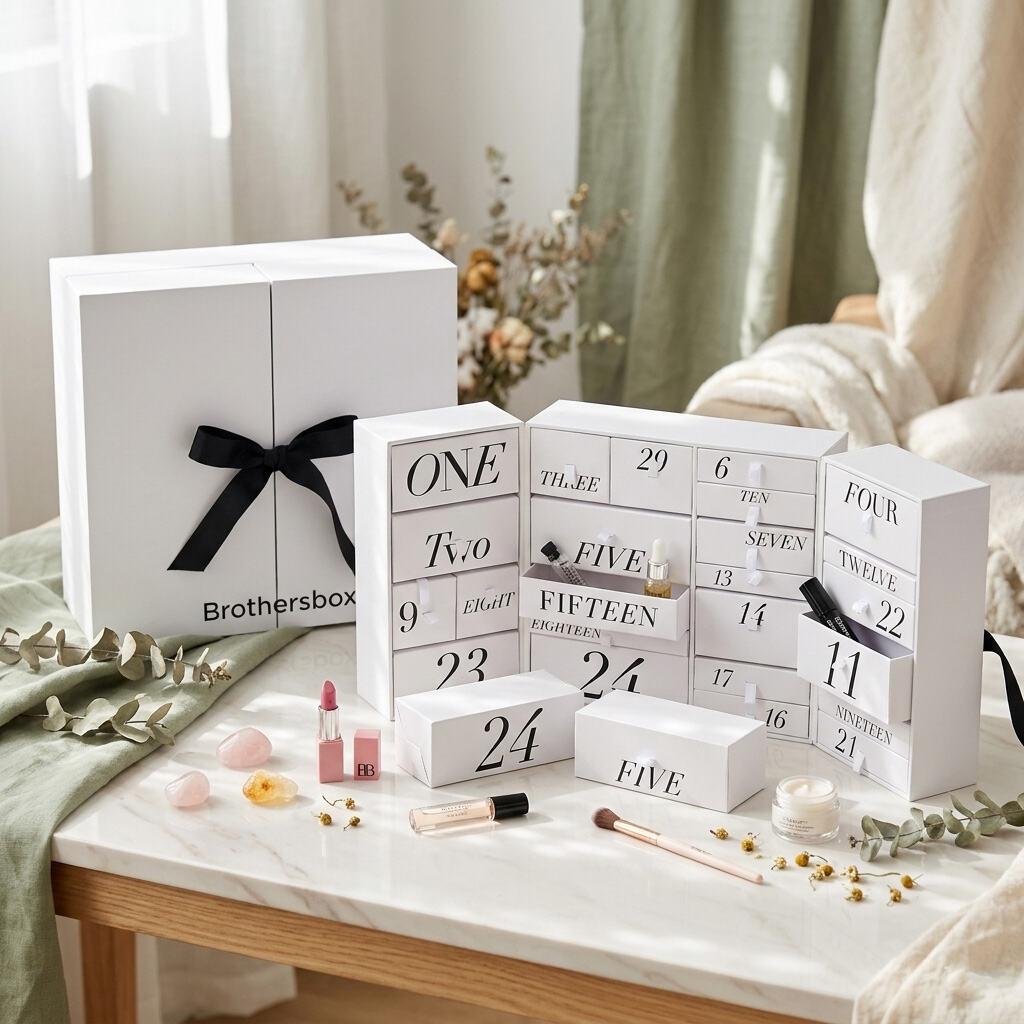
1. Custom Advent Calendar Boxes for Beauty, Chocolate, Jewelry & Gift Brands
Different products require different packaging solutions. A beauty calendar containing glass serum bottles needs a different internal structure from a chocolate calendar holding individually wrapped treats. Jewelry requires carefully fitted holders, while lifestyle collections may contain products of different sizes and weights.
The most effective approach is to develop the calendar around the products rather than selecting a standard box and attempting to fit every item inside.
Custom Cosmetic Advent Calendar Packaging for Beauty Brands
Beauty advent calendars often combine skincare, makeup, and miniature fragrance products in one collection.
A 24-day beauty calendar, for example, may contain serum bottles, face creams, lipsticks, mascara, and sample tubes. These products vary in dimensions, weight, and fragility.
Using identical compartments throughout the box can create unnecessary empty space or leave smaller products poorly supported.
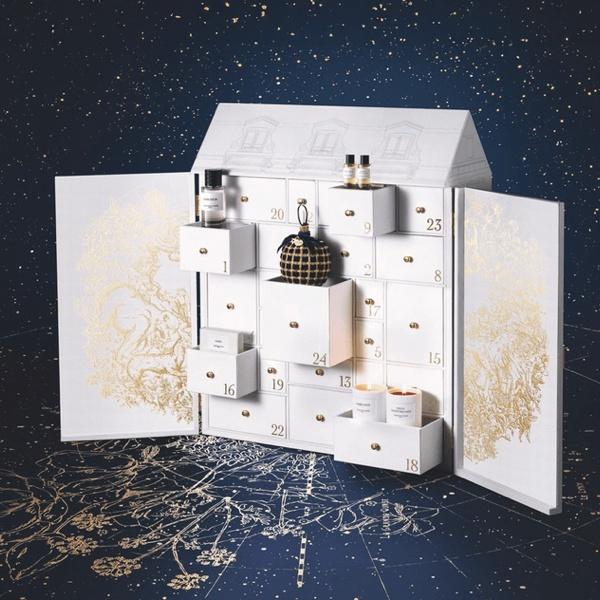
Drawer-style calendars are a popular solution because each drawer can be developed for a specific product. Magnetic double-door structures may also be considered when a more elaborate opening experience is desired.
Depending on the product assortment, the packaging can include:
- Individual drawers with different internal dimensions.
- Fitted inserts for glass bottles and cosmetic jars.
- Reinforced compartments for selected heavier products.
- Printed numbering for a coordinated countdown experience.
- Custom exterior graphics and decorative finishes.
Product access is as important as product protection. A glass bottle should remain stable during transportation but still be easy for customers to remove.
Brands developing coordinated seasonal collections can also match their advent calendars with custom cosmetic packaging boxes and custom perfume boxes using consistent materials, colors, and branding details.
Custom Chocolate Advent Calendar Boxes for Confectionery Brands
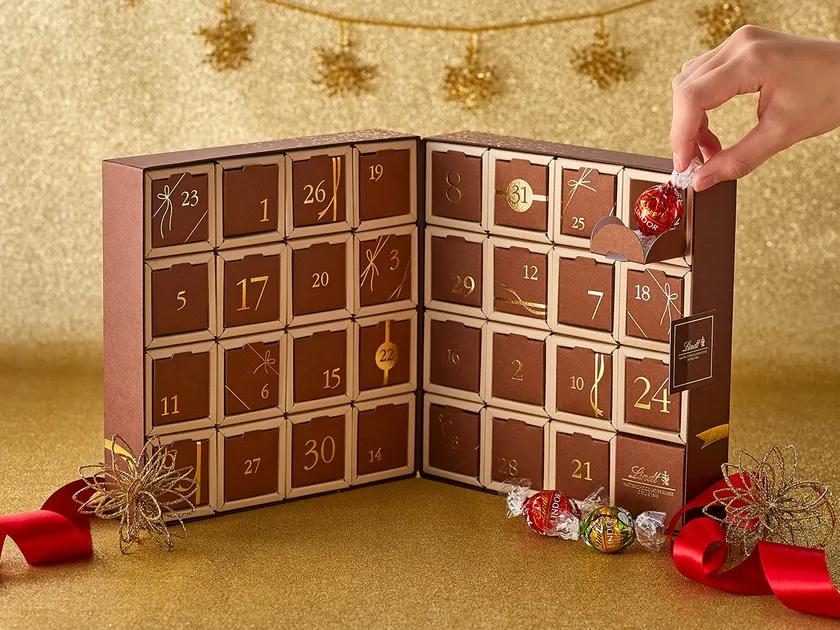
Chocolate advent calendars generally require compact compartments, clear numbering, and a structure that supports repeated opening throughout the countdown.
Printed paperboard calendars with perforated doors are commonly used for individually wrapped chocolates. Each door reveals a separate product while maintaining the appearance of the overall calendar.
Premium confectionery collections may instead use rigid drawer-style boxes, particularly when the packaging is intended for gifting.
Several details should be considered during development:
- The dimensions of each wrapped chocolate.
- The strength of the perforated opening sections.
- The arrangement of internal trays and partitions.
- The intended storage and distribution conditions.
- The suitability of materials for the packaging application.
If chocolates directly contact internal trays, paperboard surfaces, or other components, those materials must meet the applicable food-contact requirements for the intended market.
Even when chocolates are individually wrapped, accurate compartment dimensions help reduce unnecessary movement during filling and transportation.
For high-volume retail programs, printed paperboard structures may offer advantages in material consumption and shipping efficiency. Rigid calendars may be more suitable for premium gift assortments.
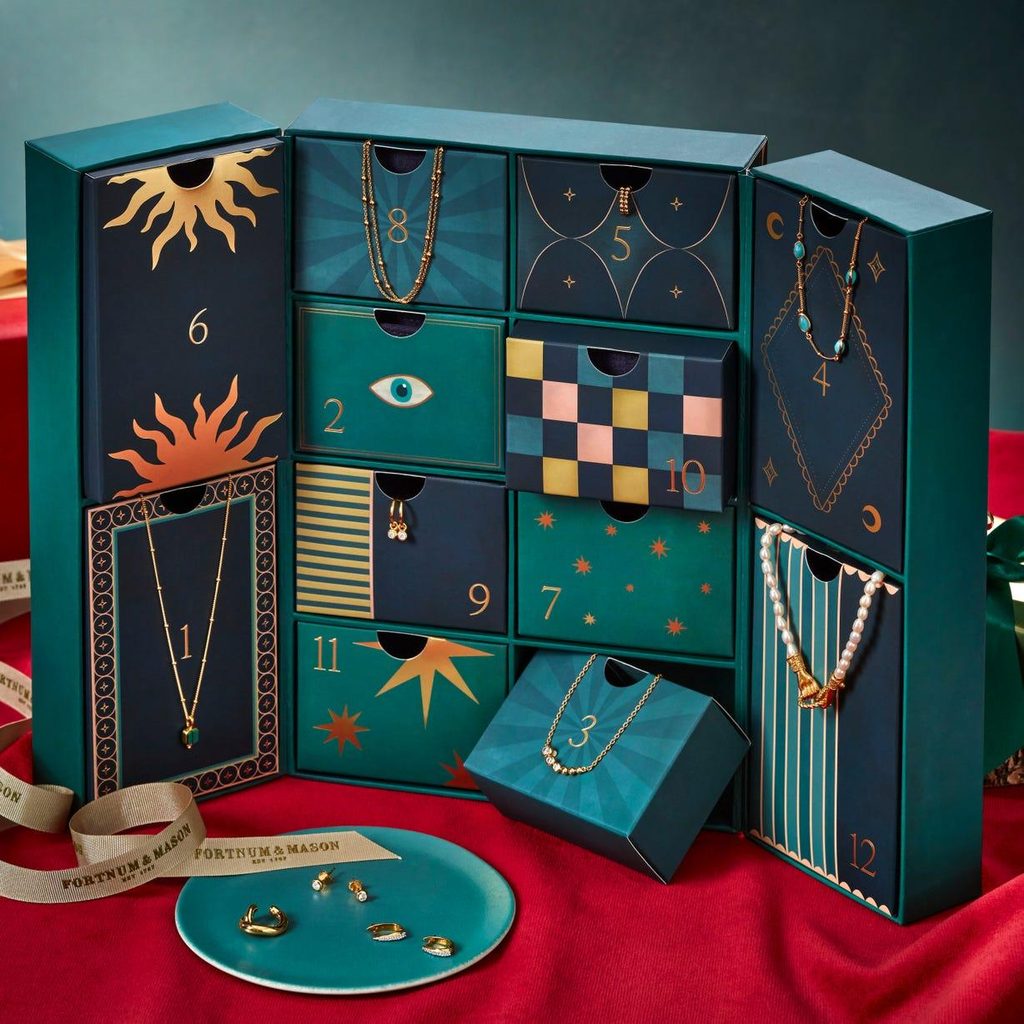
Custom Jewelry Advent Calendar Boxes for Premium Collections
Jewelry advent calendars require individual compartments that protect delicate items and provide an organized presentation.
Rings, earrings, necklaces, and bracelets cannot always be secured effectively inside identical empty drawers. Smaller pieces may shift during shipment, while necklaces can become tangled.
Custom inserts can help address these problems.
A jewelry calendar may incorporate fitted ring slots, earring holders, necklace retaining features, and fabric-covered or flocked inserts.
For example, a 12-day jewelry calendar containing different accessories may require several types of internal holders. Ring compartments can be relatively compact, while necklaces may need longer cavities and additional securing points.
Insert materials should be evaluated according to the jewelry’s finish and sensitivity. Potential surface abrasion and material compatibility should be considered during sample development.
A durable drawer calendar may also be reused after the holiday season for storing accessories.
For brands selling individual jewelry products alongside seasonal collections, coordinated custom jewelry boxes can help maintain a consistent packaging appearance.
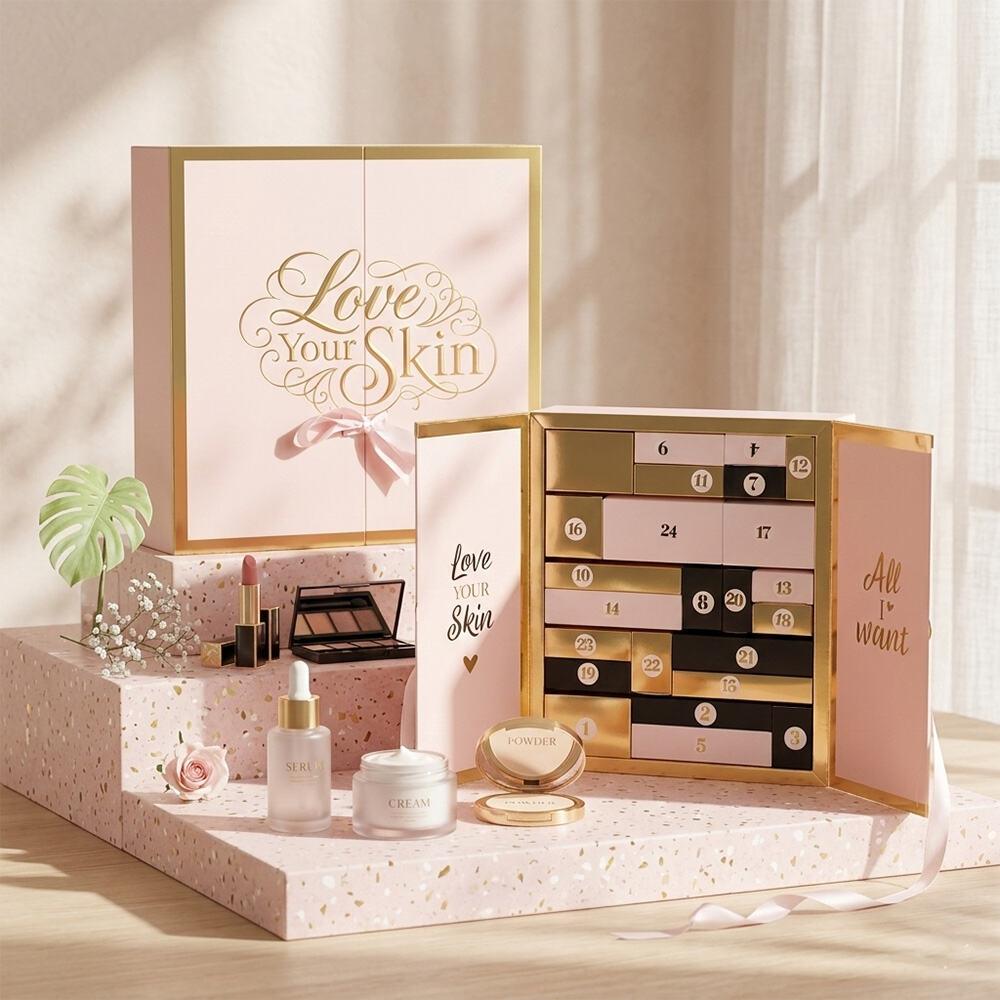
Custom Gift Advent Calendar Boxes for Lifestyle Brands
Lifestyle brands use advent calendars for stationery, tea, candles, small accessories, collectibles, and other seasonal gift products.
These collections frequently contain items with different dimensions and weights.
A calendar holding tea sachets and stationery may need only lightweight dividers, while one containing glass candle jars may require reinforced compartments and protective inserts.
Mixed-size drawers allow brands to combine different products without making every compartment unnecessarily large.
Depending on the products, possible structures include rigid drawer calendars, folding paperboard calendars, and customized compartment boxes.
For coordinated seasonal gift collections, matching custom luxury gift boxes may also be developed for related products.
Which Advent Calendar Structure Fits Your Products?
| Product Category | Suggested Structure | Main Packaging Priority |
|---|---|---|
| Cosmetics and Skincare | Rigid drawer or magnetic calendar | Product fit and easy access |
| Chocolate | Perforated-door or compartment calendar | Material suitability and opening performance |
| Jewelry | Drawer calendar with fitted inserts | Product protection and presentation |
| Fragrance | Rigid calendar with customized cavities | Glass bottle stability |
| Lifestyle Gifts | Mixed-size compartment calendar | Flexible layout and weight distribution |
| Promotional Merchandise | Printed paperboard or folding calendar | Branding and production efficiency |
The final structure should be confirmed through physical sampling and product-fit checks.
2. 12-Day vs 24-Day Advent Calendar Boxes: Which Structure Works Best?
The choice between a 12-day and a 24-day advent calendar affects more than the number of gifts included. It influences the overall dimensions, compartment arrangement, material consumption, product assortment, assembly work, and presentation.
A 12-day calendar may be more appropriate for larger or higher-value products, while a 24-day calendar can offer more opportunities for product discovery. Neither option is automatically better; the decision should reflect the intended contents and brand positioning.
When to Choose a 12-Day Advent Calendar Box
A 12-day calendar provides fewer compartments, which can make it easier to allocate more space to each product.
This format is worth considering for collections containing:
- Larger skincare products or fragrance bottles.
- Premium jewelry or accessories.
- Small candles and lifestyle gifts.
- Limited-edition products with higher individual value.
- Mixed assortments where products need more protective space.
With fewer openings, brands can design larger drawers or create a more spacious arrangement without necessarily increasing the overall packaging footprint.
However, a 12-day calendar is not automatically smaller or less expensive. Twelve large products may require more material and stronger construction than twenty-four lightweight samples.
The dimensions and weights of the actual products remain the deciding factors.
When to Choose a 24-Day Advent Calendar Box
A 24-day calendar offers a longer countdown experience and more opportunities to introduce customers to different products.
This format is commonly considered for miniature cosmetics, individually wrapped chocolates, small jewelry pieces, and compact gift assortments.
The main design challenge is accommodating more compartments within a manageable outer structure.
A calendar containing 24 drawers requires careful planning of drawer depth, partition thickness, opening clearance, and overall stability.
Using identical drawers can simplify the visual layout, but mixed-size drawers may be more practical when the products vary considerably.
The finished calendar should also be evaluated for weight distribution. Concentrating heavier items in one section can affect handling and structural performance.
Comparing 12-Day and 24-Day Advent Calendars
| Design Factor | 12-Day Calendar | 24-Day Calendar |
|---|---|---|
| Number of Openings | 12 | 24 |
| Typical Product Strategy | Fewer, potentially larger gifts | More products, often smaller items |
| Compartment Planning | More room for larger cavities | Greater emphasis on efficient layout |
| Filling and Assembly | Fewer individual positions | More individual positions |
| Outer Box Dimensions | Determined by product sizes | Determined by total product volume and structure |
| Packaging Cost | Depends on materials and complexity | Depends on materials and complexity |
| Opening Experience | Shorter countdown | Extended countdown |
How Product Dimensions Influence the Final Layout
Before selecting a calendar format, brands should prepare a complete product list.
For every item, record its dimensions, approximate weight, preferred orientation, and any special protection requirements.
The layout can then be developed around the complete assortment.
For example, a beauty calendar containing eight relatively large jars and sixteen miniature products may benefit from a mixed-size drawer arrangement. A fixed grid of identical compartments could waste space.
The final layout should also allow for structural partitions, drawer movement, and protective inserts.
A 12-day or 24-day format is therefore a starting point, not a finished structural specification.
3. How Are Custom Advent Calendar Drawer Boxes and Inserts Designed for Different Products?
The internal structure is one of the most important parts of a custom advent calendar. Even attractive exterior packaging can create problems when drawers fit poorly, products move during shipping, or customers struggle to remove individual items.
Drawer dimensions, partition thickness, insert materials, and opening clearance must be considered together. These details are best developed using actual product measurements and verified through physical samples.
Designing Drawers Around the Products
Drawer-style calendars can contain identical compartments or a combination of different sizes.
Identical drawers may be suitable when the assortment consists of similarly sized products. Mixed-size layouts are generally more practical for beauty, fragrance, jewelry, and lifestyle collections.
The design process begins by determining the space required for each item.
This includes the product’s dimensions, its packaging or protective sleeve, and the space needed for a customer to remove it.
A drawer that fits a product too tightly may be inconvenient to use. Excessive clearance, on the other hand, may allow the item to move during transportation.
The appropriate clearance should be established through sampling rather than applying the same allowance to every product.
Custom Inserts for Glass Bottles and Fragile Items
Products such as miniature fragrance bottles, skincare jars, and small glass accessories may require additional support.
Possible insert options include:
- Paperboard dividers for lightweight products.
- Die-cut paperboard inserts for defined product positions.
- Molded or fitted protective inserts where appropriate.
- Fabric-covered or flocked holders for selected premium items.
- Reinforced cavities for products requiring additional stability.
The insert should hold the item securely while allowing convenient removal.
When designing protective inserts, brands should consider the product’s weight, contact surfaces, orientation, and potential movement during handling.
The use of a thicker or more elaborate insert does not automatically guarantee better protection. Its performance depends on the complete packaging construction.
Preventing Drawer Jamming and Uneven Openings
A calendar with multiple drawers must maintain consistent operation across the entire structure.
If a drawer is too tight, customers may pull excessively and damage the surrounding paperboard. If the drawer is too loose, it may slide out unintentionally.
Several design details influence opening performance:
- Drawer dimensions and manufacturing tolerances.
- Surface materials and friction.
- Partition alignment.
- Structural deformation under load.
- Decorative finishes that affect contact surfaces.
- Changes caused by filling the drawers.
Opening performance should be checked with the actual products inside, not only with empty sample drawers.
Brands considering related custom drawer gift boxes can use similar principles to evaluate drawer movement, construction, and product fit.
What Should Be Confirmed During Sampling?
A physical sample provides an opportunity to identify practical issues before bulk manufacturing.
For a drawer-style advent calendar, the review should cover the outer dimensions, drawer arrangement, product fit, opening performance, appearance, and ease of filling.
The sample should ideally be tested with the intended products or representative items of the correct dimensions and weight.
It is also useful to confirm whether the brand will fill the calendar manually or through an established packing operation.
These details can influence drawer access, insert design, and assembly efficiency.
Once the structure is approved, the final drawings and material specifications should be confirmed before production.
4. Custom Printed Advent Calendar Boxes: Materials, Logo Printing & Luxury Finishes
Materials and decorative finishes influence both the appearance and performance of an advent calendar. A printed folding carton may be appropriate for lightweight retail products, while a rigid paperboard structure can provide more support for multiple drawers and heavier gift assortments.
LVPACK offers customization options for structure, paper materials, logo printing, and decorative finishes. The right combination should reflect the brand’s design, product weight, budget, and intended distribution conditions.
Choosing Paperboard and Rigid Box Materials
Advent calendars can be developed using different paper-based constructions.
Folding paperboard structures are often suitable for compact calendars containing lightweight products.
Rigid calendars commonly use a thicker board core covered with printed, textured, or decorative paper.
The selected board thickness should be based on the required dimensions, number of compartments, total product weight, and structural design.
A larger calendar is not necessarily stronger simply because it uses thicker paperboard. The arrangement of internal partitions and the way the structure is assembled also influence performance.
For premium gift calendars, the relationship between the outer board, covering paper, and internal compartments should be evaluated as a complete construction.
Custom Logo Printing and Brand Colors
Brand consistency is particularly important for seasonal products sold alongside an existing collection.
Calendar artwork may include numbered compartments, product illustrations, seasonal graphics, and brand-specific colors.
Common printing considerations include:
- CMYK printing for full-color illustrations and photographic artwork.
- Pantone color matching for selected brand colors where appropriate.
- Clear numbering and legible small text.
- Consistent artwork placement across doors or drawers.
- Alignment between printed graphics and structural openings.
Artwork should be reviewed on the actual packaging layout.
For example, a graphic crossing several drawer fronts requires careful alignment so the completed calendar presents a coherent design.
Small changes in paper texture or lamination can also affect the perceived color and appearance of the finished product.
Foil Stamping, Embossing and Other Finishing Options
Decorative finishes can create a distinctive seasonal presentation.
| Finishing Option | Visual Effect | Design Consideration |
|---|---|---|
| Foil Stamping | Metallic or decorative accents | Position, detail size, and substrate suitability |
| Embossing | Raised surface detail | Board and paper compatibility |
| Debossing | Recessed surface detail | Depth and structural requirements |
| Spot UV | Selective gloss contrast | Artwork alignment and coating compatibility |
| Matte Lamination | Reduced surface gloss | Desired appearance and material characteristics |
| Gloss Lamination | Reflective finish | Surface appearance and handling requirements |
| Textured Paper | Tactile surface character | Print reproduction and finishing suitability |
Not every finish is suitable for every calendar design.
A detailed foil pattern may require adjustment when applied across narrow drawer fronts. Deep embossing may be less practical near certain folds or structural edges.
A simple combination of well-selected materials and a restrained finishing treatment can sometimes communicate a premium brand identity more effectively than numerous decorative processes.
Matching Finishes Across Seasonal Packaging
Many brands develop an advent calendar as part of a wider holiday collection.
Using consistent materials and artwork across calendars, magnetic gift boxes, and other seasonal packaging can help create a coordinated retail presentation.
When several packaging formats are being produced, sample approval becomes especially important for color consistency and finishing expectations.
5. How Do We Make Custom Calendar Boxes Strong Enough for Shipping and Daily Opening?
An advent calendar may be opened repeatedly over several weeks, but it also has to survive the journey from production to the customer. Structural strength, drawer performance, product retention, and outer-carton protection all contribute to the final packaging experience.
These requirements are best addressed during development, when materials and internal structures can still be adjusted without disrupting an approved production design.
Supporting the Weight of Multiple Products
Calendar packaging can be considerably heavier once all compartments are filled.
A box containing twenty-four lightweight chocolates presents different structural demands from one containing several glass skincare jars.
Important considerations include the total filled weight, where heavier products are positioned, and how the load is transferred through the internal partitions and outer shell.
For larger rigid calendars, partitions may need additional reinforcement to limit distortion.
The calendar should be evaluated in its filled condition because an empty sample may not reveal how the structure behaves under load.
Keeping Products Secure During Transportation
Products can shift when cartons are moved, tilted, or handled during distribution.
A suitable internal insert can reduce movement, but it must also be compatible with the product’s shape and surface.
For glass bottles, the design may need to control contact with neighboring components and prevent excessive movement within the cavity.
For jewelry, product-retaining features can help keep accessories in place.
For lightweight products, accurately sized paperboard compartments may be sufficient without adding unnecessary protective materials.
The objective is to provide protection appropriate to the actual product rather than using the same insert design for every calendar.
Checking Drawers, Doors and Repeated Opening
The opening experience should remain consistent after the calendar has been filled.
During sample evaluation, brands should check whether drawers slide smoothly, doors open without tearing unintended areas, and the outer structure remains stable.
For a 24-day calendar, it is useful to evaluate different positions across the box rather than testing only one drawer.
Potential concerns include:
- Drawers that are too tight or too loose.
- Misaligned internal partitions.
- Weak pull tabs or opening features.
- Friction caused by surface finishes.
- Distortion when compartments are filled.
- Damage to nearby openings during use.
Any issues identified during sampling should be corrected before approving the production structure.
Preparing Advent Calendars for Export Shipping
The individual calendar is only one part of the shipping system.
Master cartons, packing orientation, protective materials, and pallet arrangements can all influence the condition of the finished packaging on arrival.
The packing method should reflect the calendar’s dimensions, filled weight, surface finishes, and intended transportation route.
For high-value or fragile assortments, additional packaging evaluation may be appropriate.
LVPACK can discuss packaging construction and packing requirements during project development so that presentation and distribution needs are considered together.
6. Inside Our Calendar Box Factory: From Custom Samples to Bulk Production
Developing a custom advent calendar requires coordination between product specifications, structural drawings, artwork, materials, manufacturing, and final assembly.
LVPACK supports custom paper packaging projects through design development, sampling, printing, production, and quality inspection. The exact manufacturing steps depend on the approved calendar structure and the requirements of the order.
Step 1: Review the Product Assortment and Packaging Requirements
The first stage is understanding what the calendar needs to contain.
Brands can provide a product list, individual dimensions, approximate weights, preferred number of compartments, reference images, and expected order quantity.
If the calendar will contain products of different sizes, the complete assortment should be reviewed before the compartment layout is finalized.
Destination market and target delivery date are also important because they can affect materials, production planning, and transportation arrangements.
Step 2: Develop the Structural Layout
After reviewing the requirements, the packaging structure can be planned.
This involves evaluating the outer box dimensions, drawer or door arrangement, partitions, inserts, and opening method.
For a mixed-size collection, several layout options may be considered to balance compact dimensions and practical product access.
The structure should also accommodate the brand’s intended artwork and decorative finishes.
Step 3: Produce and Review a Physical Sample
Physical sampling is an important stage for custom advent calendar packaging.
The sample helps the brand evaluate dimensions, opening performance, product fit, material appearance, and overall presentation.
Whenever practical, the intended products should be placed inside the sample.
If revisions are needed, they can be made before the final construction and artwork are approved.
Sampling may involve more than one round, depending on the complexity of the design and the changes requested.
Step 4: Confirm Artwork, Materials and Production Details
Once the structure is agreed, the project moves toward production preparation.
Artwork files, printing requirements, material specifications, finishing details, and quantities need to be confirmed.
For numbered calendars, it is particularly important to verify that the printed numbers correspond to the approved compartment arrangement.
A clear approval process helps reduce avoidable production errors and misunderstandings.
Step 5: Printing, Finishing and Assembly
Bulk production follows the approved specifications.
Depending on the design, the process may involve printing, surface finishing, die cutting, board preparation, covering, partition construction, drawer assembly, and final packaging.
Calendars with many individual drawers generally require more assembly work than simpler paperboard structures.
The production method should be considered when evaluating the calendar’s design complexity and delivery requirements.
Step 6: Quality Inspection and Packing
Finished packaging should be checked against the approved sample and order specifications.
Relevant inspection points may include dimensions, printing appearance, surface defects, structural alignment, drawer operation, and the condition of the finished cartons.
Packing requirements should also be confirmed so that the calendars are protected during storage and international transportation.
For seasonal products, keeping the approved design, production requirements, and delivery arrangements aligned is especially important.
7. Wholesale Advent Calendar Boxes: MOQ, Custom Pricing & Christmas Production Lead Times
Wholesale advent calendar pricing depends on the structure, dimensions, materials, number of compartments, printing requirements, decorative finishes, and order quantity.
Because custom calendars can vary greatly in complexity, a reliable quotation needs more information than the exterior box size alone.
LVPACK offers custom packaging with a starting MOQ of 1,000 pieces, subject to the selected structure and project specifications.
What Affects Custom Advent Calendar Box Pricing?
Two calendars with similar outer dimensions can have very different manufacturing requirements.
A simple printed paperboard calendar may use relatively few components, while a rigid drawer calendar may contain numerous individual drawers, partitions, covering materials, and decorative details.
The main quotation factors include:
| Pricing Factor | How It Affects the Project |
|---|---|
| Box Dimensions | Determines material usage and shipping volume |
| Number of Compartments | Influences construction and assembly work |
| Box Structure | Affects component count and manufacturing complexity |
| Paperboard and Covering Materials | Influences material cost and appearance |
| Protective Inserts | Adds product-specific design and assembly requirements |
| Printing and Finishes | Influences production processes and setup requirements |
| Order Quantity | Affects production planning and unit-cost allocation |
| Packing Requirements | Influences carton configuration and logistics |
A complex calendar is not necessarily the best option for every collection.
Some brands may benefit from simplifying the internal arrangement, limiting unnecessary finishes, or selecting a more efficient structure.
These decisions should be evaluated without compromising the packaging’s required product protection and opening performance.
Minimum Order Quantity for Wholesale Advent Calendars
LVPACK’s custom packaging MOQ starts at 1,000 pieces.
Actual minimum quantities may depend on the selected materials, printing process, dimensions, and structural complexity.
For custom advent calendars, brands should confirm the required quantity before beginning detailed design work.
Knowing the estimated order volume helps the manufacturer assess suitable construction methods and production arrangements.
If the project involves several calendar variations, quantities for each design should be stated separately.
Planning Production for Christmas and Seasonal Launches
Christmas calendars have a fixed selling season, making early planning especially valuable.
The project timeline should account for more than manufacturing alone.
A typical development sequence includes:
- Product assortment and packaging requirements.
- Structural design and initial quotation.
- Physical sample development.
- Sample evaluation and possible revisions.
- Final artwork and material approval.
- Bulk manufacturing and quality inspection.
- Packing, international transportation, and delivery.
The time required for each stage depends on the design complexity, approval speed, order quantity, production schedule, and shipping method.
Brands should avoid assuming that an initial quotation is also a confirmed production or delivery commitment.
A final schedule should be agreed after the construction, specifications, quantity, and relevant logistics arrangements have been reviewed.
How to Request an Accurate Wholesale Quotation
To make the quotation process more efficient, provide as much relevant information as possible.
Useful details include the number of compartments, expected finished dimensions, individual product measurements, preferred structure, quantity, artwork requirements, and destination country.
Reference images are helpful, but they should be accompanied by the actual products’ dimensions whenever possible.
If the structure has not yet been decided, LVPACK can review the product assortment and discuss practical packaging options before the final specifications are established.
8. Custom Advent Calendar Box FAQs: Sizes, Materials, Orders & Shipping
Custom advent calendar packaging raises questions about structure, minimum quantities, protective inserts, printing, materials, and seasonal delivery. The following answers cover common considerations for brands planning a new collection.
Can I customize the size and number of compartments?
Yes. Custom calendar packaging can be developed around different compartment counts and product dimensions.
Common concepts include 12-day and 24-day calendars, but other arrangements can also be evaluated.
The final layout depends on the products, box structure, and manufacturing feasibility.
Can different products fit inside the same calendar?
Yes. Mixed-size drawers and individually designed inserts can accommodate products with different dimensions.
Providing accurate product measurements and approximate weights is important for developing a suitable internal layout.
Which structure is better for premium advent calendars?
Rigid drawer calendars and magnetic double-door designs are often considered for premium collections.
The most appropriate option depends on the products’ weight, desired opening experience, branding requirements, and budget.
A more elaborate structure is not automatically the best choice.
Can LVPACK customize the logo and printing?
LVPACK supports custom printing, brand colors, artwork, and decorative finishes.
Options may include CMYK printing, selected Pantone colors, foil stamping, embossing, debossing, and other surface treatments.
The suitability of each finish should be confirmed for the chosen materials and structure.
Do advent calendar boxes need protective inserts?
Not every calendar requires a separate protective insert.
Lightweight products may fit securely inside accurately sized paperboard compartments.
Glass bottles, delicate accessories, or irregularly shaped items may require fitted inserts or additional support.
The choice should be based on the product’s characteristics and handling requirements.
Can advent calendar packaging be used for chocolates?
Yes, provided that the packaging design and materials are suitable for the intended use.
Where chocolate directly contacts packaging components, applicable food-contact requirements must be met.
Product wrapping, storage conditions, and destination-market requirements should be reviewed before finalizing materials.
What is the minimum order quantity?
LVPACK’s custom packaging MOQ starts at 1,000 pieces.
The applicable minimum for a particular calendar design should be confirmed according to its materials, construction, and production requirements.
Can I request a sample before bulk production?
Custom packaging samples can be developed to evaluate the proposed structure, dimensions, materials, printing, and product fit.
Sample requirements, costs, and development arrangements should be confirmed during the quotation process.
How long does custom advent calendar production take?
Production time varies according to the approved structure, materials, decorative finishes, quantity, and factory schedule.
Sampling and customer approvals should also be included in the overall project timeline.
For Christmas collections, early planning helps provide more flexibility for revisions and international shipping.
Can LVPACK arrange international delivery?
International packing and shipping requirements can be discussed as part of the project.
The appropriate arrangement depends on the order quantity, carton dimensions, destination, shipping method, and agreed commercial terms.
What information should I send to receive a quotation?
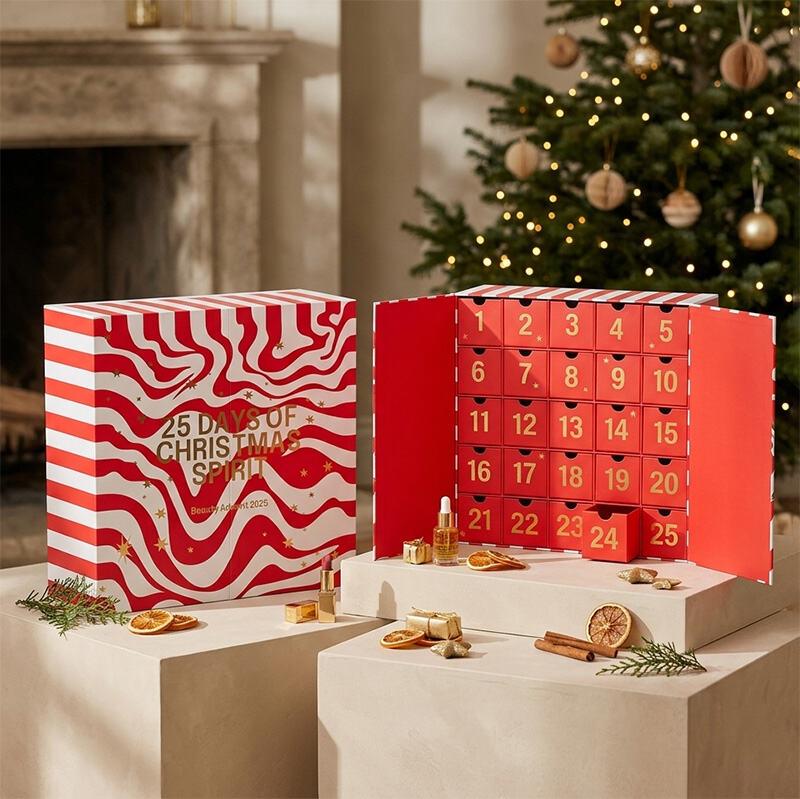
Please provide your product list, compartment count, product dimensions, preferred box structure, estimated order quantity, artwork or reference images, destination country, and required delivery date.
This information helps the team evaluate the project and prepare a more relevant quotation.
9. Start Your Custom Advent Calendar Packaging Project with LVPACK
A custom advent calendar project begins with a clear understanding of the products, packaging structure, brand presentation, and delivery requirements.
Whether you are developing a beauty discovery collection, a chocolate countdown calendar, a jewelry gift assortment, or a mixed seasonal gift set, LVPACK can review your requirements and discuss suitable packaging solutions.
Our customization services cover box structure, material selection, compartment arrangements, protective inserts, printing, decorative finishes, sampling, and bulk manufacturing.
You do not need to have a completed structural drawing before making an inquiry. Product details, initial concepts, or reference images can provide a useful starting point.
Tell Us About Your Calendar Packaging Requirements
To discuss your project, please share:
- Your product category and product assortment.
- The number of compartments required.
- Product dimensions and approximate weights.
- Your preferred box structure or reference images.
- Logo, artwork, colors, and finishing preferences.
- Estimated order quantity.
- Destination country and target delivery date.
If you are comparing several packaging structures, include your main priorities, such as product protection, opening experience, shipping efficiency, or target budget.
The LVPACK team can use this information to evaluate possible manufacturing approaches and discuss the next steps for sample development.
Request a Custom Advent Calendar Box Quotation
Creating a successful seasonal collection requires packaging that fits the products, communicates the brand’s identity, and supports practical production and distribution.
LVPACK works with brands to develop customized paper packaging based on their specific product and order requirements.
Share your calendar concept and product specifications with our team to discuss suitable structures, materials, finishing options, and quotation details.
Contact LVPACK today to start planning your custom advent calendar packaging project.