What Should You Consider When Ordering Custom Wine Boxes?

Choosing the right custom wine boxes involves more than creating an attractive package. The box needs to fit your bottle, reflect your brand, suit its intended use, and meet your budget. A design that looks good on screen may not work well in practice if the bottle moves inside, the packaging is too bulky, or the finished box is difficult to handle.
For wineries, wine distributors, retailers, and corporate gifting companies, packaging requirements depend on how the wine will be presented and delivered. A premium gift for a business partner has different priorities from a retail product or a wine set shipped directly to consumers.
Before requesting a quotation, focus on three essentials: bottle compatibility, packaging purpose, and total project cost. Defining these requirements early helps your manufacturer recommend a suitable solution and reduces avoidable design changes.
1. Match the Box Dimensions to Your Wine Bottle
Wine bottles vary in height, diameter, shoulder shape, base dimensions, and neck length. Even bottles with similar capacities may require different internal dimensions. Champagne bottles and specialty wine bottles may also need different packaging from standard wine bottles.
Before developing your custom wine box, prepare these details:
Bottle dimensions: Overall height, maximum diameter, and closure height where relevant.
Bottle shape: Shoulder profile, base shape, and any unusual contours.
Bottle quantity: Whether the box will contain one bottle or multiple bottles.
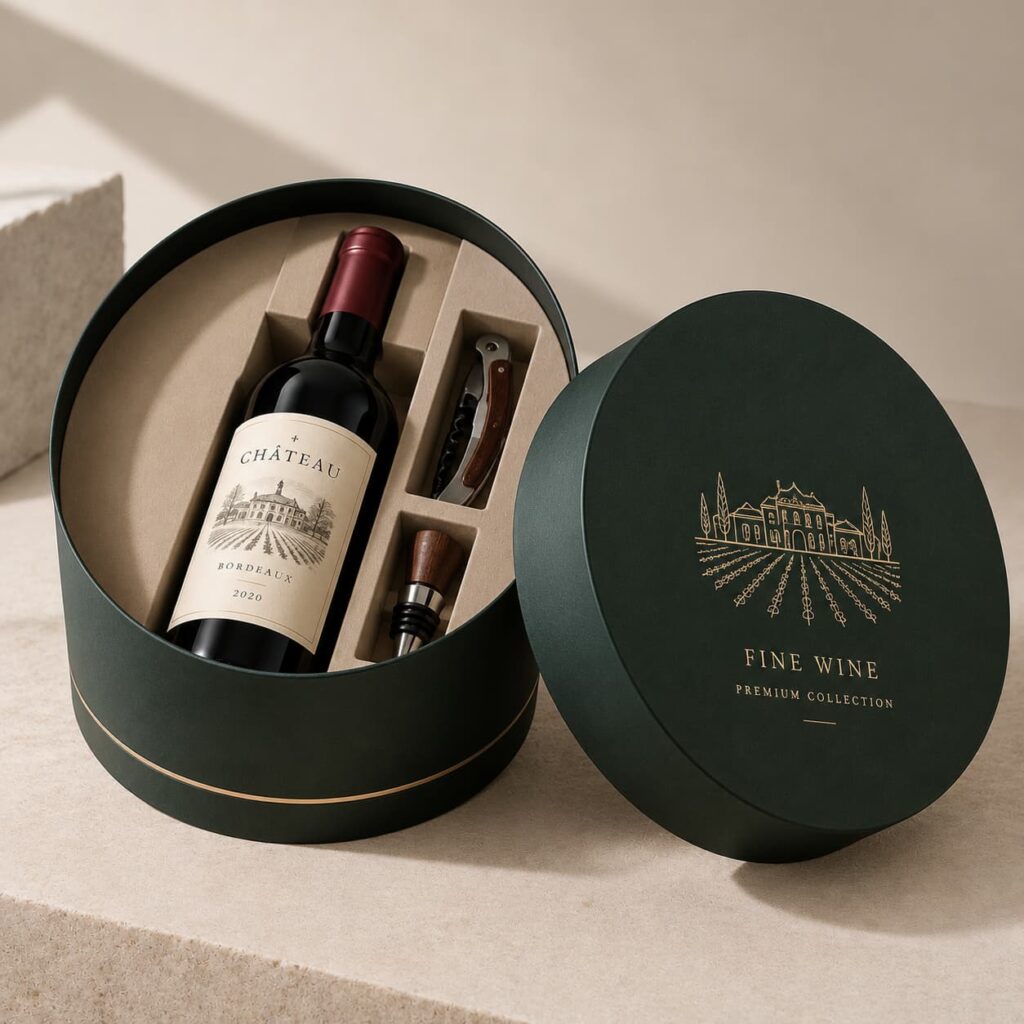
Additional contents: Wine glasses, bottle openers, greeting cards, or other gift items.
Handling requirements: How the packaged product will be stored, transported, and delivered.
Accurate measurements help the manufacturer determine the internal space and required support. Remember that the insert, box walls, and closure also occupy space, so the design should account for the complete packaging assembly rather than the bottle alone.
A practical approach is to confirm the bottle dimensions first, plan the internal space, and then finalize the external box size. If possible, provide a physical bottle or an accurate dimensional drawing before sampling.
2. Balance Presentation, Protection, and Cost
A wine box needs to present the product appropriately while providing suitable support during handling and transportation. The right balance depends on your product positioning and sales channel.
| Packaging purpose | Main priority | What to consider |
| Premium wine gifts | Presentation and perceived value | Exterior appearance and a well-fitted interior |
| Retail packaging | Product recognition and practicality | Branding, dimensions, and storage efficiency |
| Corporate gifts | Professional and consistent presentation | Logo placement and repeat-order consistency |
| E-commerce delivery | Protection during transportation | Bottle positioning and suitable outer packaging |
A more elaborate box is not always a better choice. Oversized packaging can increase material use and shipping volume, while unnecessary components may add cost without improving the customer experience.
When evaluating a design, ask whether it holds the bottle securely, matches the intended price point, and can be produced consistently at your planned order quantity. If the box will be shipped directly to customers, also clarify whether a separate shipping carton is required.
The best solution is the one that meets your presentation and protection needs without adding unnecessary complexity or cost.
3. Choose Packaging for Your Sales Channel
The intended use of your wine packaging should guide the design from the beginning. Different applications create different expectations for appearance, convenience, and budget.
Retail wine packaging should complement the bottle and help customers recognize the brand. Clear graphics, suitable dimensions, and practical storage can be more valuable than excessive decoration.
Corporate wine gift boxes may need a company logo, personalized messages, or space for additional gift items. For larger orders, consistent artwork and repeatable production are particularly important.
Special-edition wine packaging may be developed for holidays, product launches, anniversaries, or limited releases. Distinctive materials and decorative details can support the concept, but each addition should be evaluated against the budget and production schedule.
E-commerce wine packaging needs to account for the delivery process. A presentation box may require an outer shipping carton or additional protection, depending on the bottle and shipping conditions.
Before choosing a design, identify your main objective. Are you trying to improve retail presentation, create a premium gifting experience, maintain consistent corporate branding, or prepare wine for delivery?
Defining this priority helps your manufacturer recommend a solution based on practical requirements rather than appearance alone.
4. Prepare the Right Information Before Requesting a Quote
A clear project brief helps your packaging manufacturer understand your requirements and provide a more relevant quotation. You do not need to finalize every design detail before making an inquiry, but the following information is a useful starting point.
Custom Wine Box Inquiry Checklist
Bottle specifications: Height, diameter, and bottle shape.
Order quantity: Estimated number of boxes required.
Intended use: Retail, corporate gifting, special editions, or e-commerce.
Design references: Photos, sketches, existing packaging samples, or brand guidelines.
Branding requirements: Logo artwork, preferred colors, and personalization.
Additional contents: Glasses, accessories, or other gift items.
Budget and schedule: Target cost and required delivery date.
If some details are still undecided, share what you know and explain your priorities. For example, you may have a bottle sample and a target budget but need advice on the most suitable packaging direction.
Providing bottle dimensions, estimated quantity, and reference images gives LVPACK a practical starting point for discussing your custom wine box project.
Ready to develop custom wine boxes for your brand? Contact LVPACK with your bottle specifications, order quantity, intended application, and design references to discuss a suitable packaging solution.
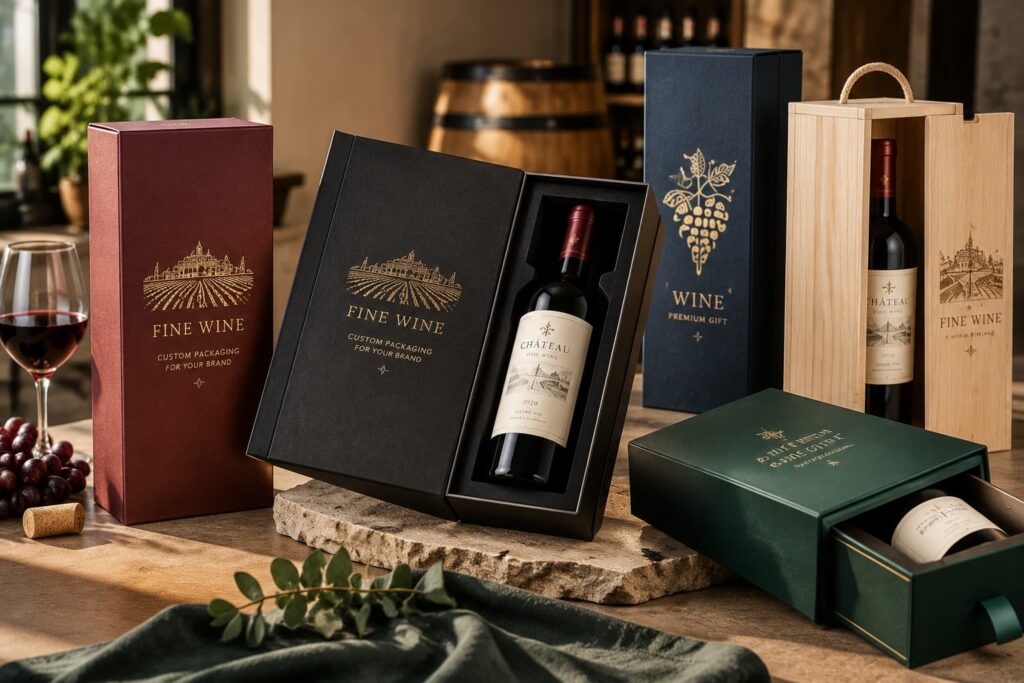
Which Custom Wine Gift Boxes Best Fit Your Bottle and Gifting Needs?
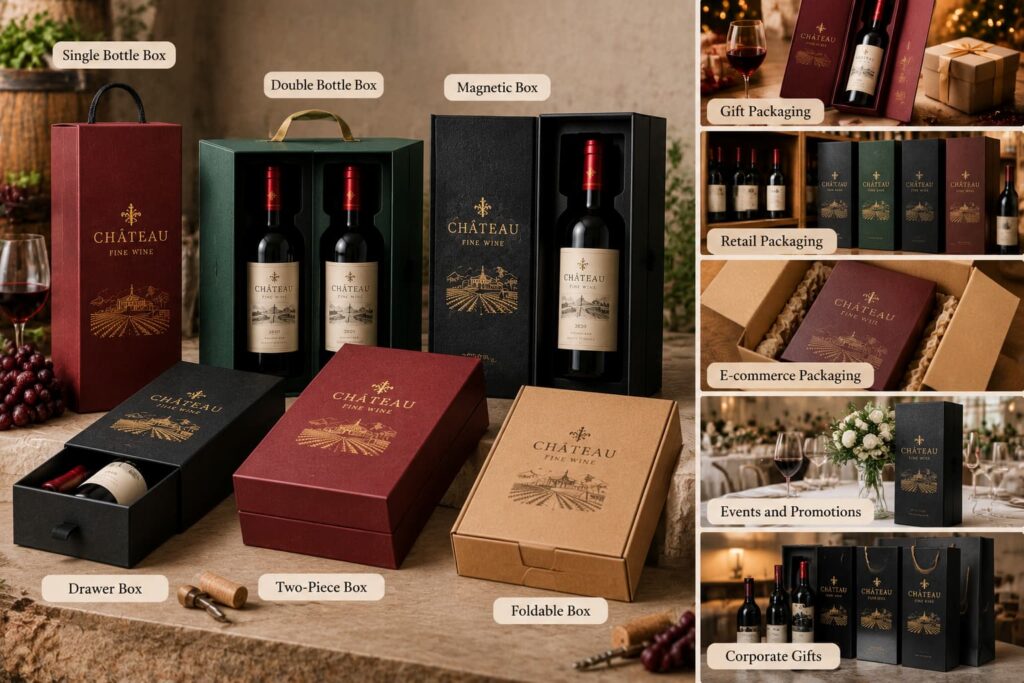
The right custom wine gift boxes should suit the bottle, the occasion, and the way the product will be presented. A single-bottle gift may need a compact, premium box, while a multi-bottle collection requires enough space to organize the bottles and keep them separated.
For wineries, distributors, and corporate gifting businesses, the best design depends on bottle quantity, presentation requirements, budget, and intended use. Choosing the structure around these factors helps avoid unnecessary complexity and creates packaging that works for both the brand and the recipient.
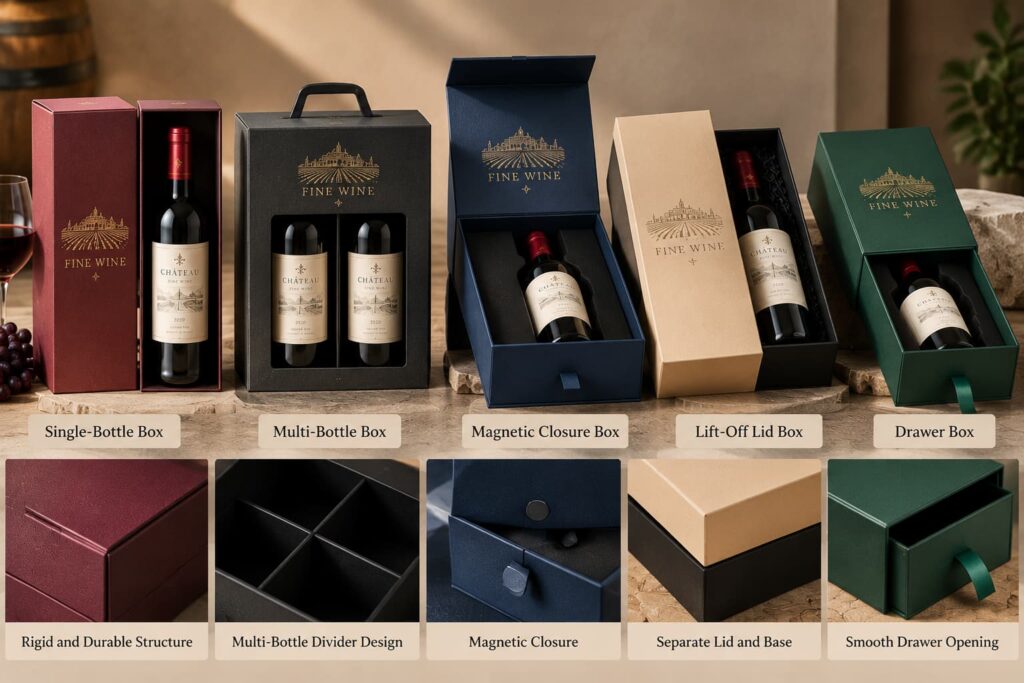
1. Single-Bottle Wine Gift Boxes
A single-bottle wine gift box is suitable for premium wine gifts, promotional campaigns, and special-edition releases. Its dimensions can be tailored to one bottle, helping create a neat presentation without excessive packaging space.
Rigid boxes are worth considering when a firm structure and premium appearance are important. Folding boxes may be more suitable when lightweight construction and efficient storage are priorities.
When choosing a single-bottle design, consider:
Bottle fit: The internal dimensions should match the bottle.
Presentation: The exterior should complement the wine label and brand identity.
Practicality: The bottle should be easy to place inside and remove.
Cost: The structure should suit the product’s positioning and order quantity.
A premium winery may prioritize a refined gift presentation, while a distributor ordering larger quantities may place more emphasis on consistent production and practical handling.
2. Multi-Bottle Wine Gift Boxes
Multi-bottle wine gift boxes are commonly considered for corporate gifts, wine collections, tasting sets, and promotional bundles. These designs need to accommodate several bottles while managing their combined weight and keeping the contents organized.
Custom dividers can separate bottles and reduce direct contact during normal handling. The internal layout should be based on the actual bottle dimensions, particularly when a set contains different bottle shapes or sizes.
Before finalizing a multi-bottle design, confirm:
The number and arrangement of bottles.
The space required for dividers and internal supports.
Whether accessories or gift items are included.
The overall package weight and external dimensions.
Whether a separate shipping carton is needed.
For larger sets, develop the internal arrangement before finalizing the external box dimensions. This helps avoid wasted space and makes the packaging easier to assemble and use.
3. Magnetic Closure Wine Boxes
A magnetic closure wine box features a hinged cover with a magnetic fastening mechanism. It can create a structured opening experience and provide space for prominent branding, making it an option for premium gifts and corporate wine packaging.
The design should be checked for cover alignment, closure strength, and compatibility with the internal insert. These details affect whether the box closes properly and feels convenient to use.
Choose this structure when the hinged opening and presentation support your brand objectives. If a simpler design can deliver the same result, it may offer a more practical use of the packaging budget.
4. Lift-Off Lid Wine Boxes
A lift-off lid wine box uses a separate lid that fits over the base. This classic structure can suit traditional wine gifts, retail packaging, and selected gift sets.
The key consideration is the fit between the lid and base. A lid that is too tight may be difficult to remove, while one that is too loose may make the box feel less secure.
Board thickness, wrapping materials, box dimensions, and insert placement can all affect the final fit. A sample should be checked before production to confirm that the lid opens smoothly and the bottle sits correctly inside.
5. Drawer Wine Boxes
A drawer wine box uses a sliding inner tray and an outer sleeve. It offers a different opening experience and can accommodate a bottle or a coordinated gift set, depending on the design.
Before selecting this structure, consider the smoothness of the drawer movement, the available space for inserts, and the ease of assembly. Excessive friction can make the box difficult to open, while too much clearance may make it feel loose.
Drawer boxes are best considered when the sliding presentation adds value to the product. For projects with simpler requirements, another structure may achieve the desired result with less complexity.
6. Compare Wine Box Structures Before Choosing
| Box structure | Best suited for | Main consideration |
| Single-bottle rigid box | Premium individual wine gifts | Presentation and bottle fit |
| Multi-bottle box | Wine collections and corporate gifts | Bottle separation and combined weight |
| Magnetic closure box | Premium branded gifts | Closure alignment and construction cost |
| Lift-off lid box | Classic wine gift packaging | Lid fit and ease of opening |
| Drawer box | Distinctive gift sets | Tray movement and assembly |
| Folding wine box | Lightweight, space-conscious packaging | Structural requirements and intended use |
No single structure is ideal for every project. The right choice depends on bottle configuration, brand positioning, order quantity, and how the finished package will be handled.
Discuss Your Custom Wine Gift Box with LVPACK
Share your bottle dimensions, number of bottles per box, preferred design, and estimated order quantity with LVPACK. These details provide a practical starting point for discussing a custom wine gift box that fits your product and project requirements.
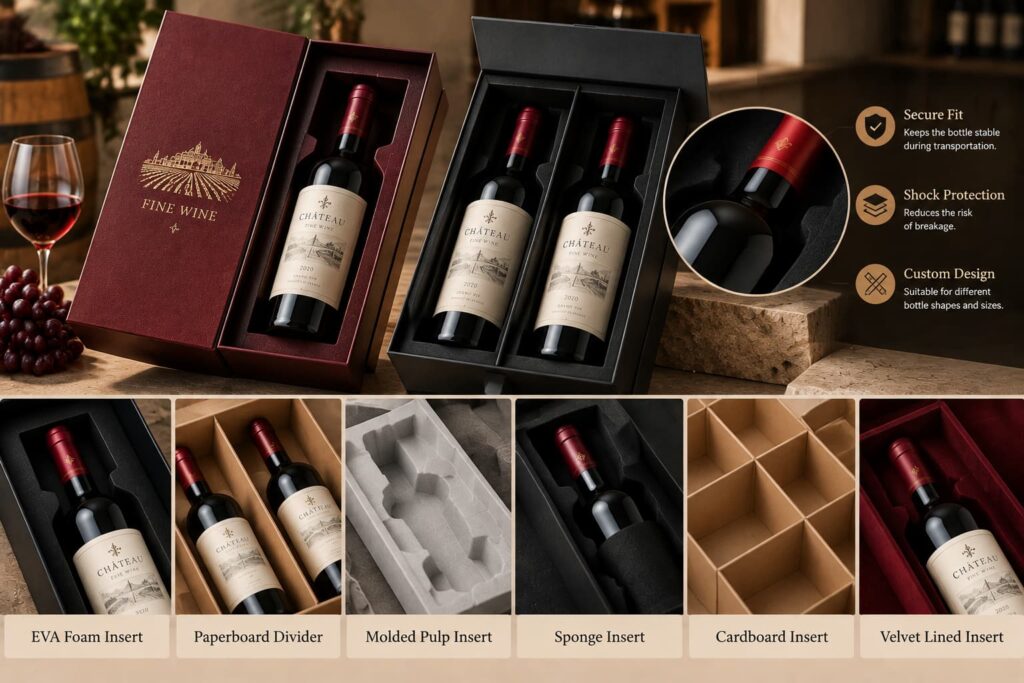
How Can Custom Wine Box Inserts Improve Bottle Protection?
Custom wine box inserts help keep bottles positioned inside the box, organize gift sets, and improve the overall presentation. The right insert depends on bottle dimensions, weight, box structure, and intended shipping conditions. A design that works for one bottle may not provide suitable support for another bottle with a different shape or weight.
For wine brands and gift packaging buyers, the goal is to balance bottle stability, convenient removal, and practical production costs.
1. Design Inserts Around Actual Bottle Dimensions
Wine bottles vary in height, diameter, shoulder shape, and base dimensions. These differences affect how the bottle sits inside the packaging and where support is needed.
Before developing a custom insert, confirm:
Bottle height and diameter: Establish the required internal space.
Bottle shape: Account for the shoulders, base, and neck.
Bottle weight: Consider the support needed for the finished package.
Additional contents: Allow space for glasses, accessories, or gift items.
Box dimensions: Ensure the insert fits without interfering with the lid.
Whenever possible, provide a physical bottle or accurate dimensional drawings. A sample can help identify fit issues before bulk production.
The insert should hold the bottle securely without making it difficult to remove. The best fit is stable and practical, not simply as tight as possible.
2. Compare Wine Box Insert Materials
Different insert materials offer different combinations of structure, appearance, and cost. The right option depends on the packaging design and the level of support required.
| Insert material | Potential advantages | Considerations |
| Paperboard | Lightweight and adaptable to paper packaging | Board thickness and construction must suit the bottle |
| Foam | Can be shaped around specific bottle profiles | Material selection, appearance, and disposal requirements |
| Molded pulp | Supports shaped, fiber-based packaging designs | Mold development, surface finish, and dimensional accuracy |
| Other custom trays | Can accommodate specialized layouts | Suitability depends on the material and application |
Paperboard may suit coordinated paper gift boxes, while foam can be considered for shaped cavities or sets containing accessories. Molded pulp may be an option for projects seeking fiber-based inserts.
No material is automatically suitable for every wine bottle or shipping situation. Confirm the insert’s dimensions, structural performance, and compatibility with the intended packaging before approving production.
3. Use Custom Dividers for Multi-Bottle Wine Boxes
Custom wine box dividers separate bottles and help keep multi-bottle gift sets organized. They are particularly useful for corporate gifts, tasting collections, and packaging containing different wine varieties.
A suitable divider design should account for:
The number and arrangement of bottles.
Differences in bottle diameter and shape.
The combined weight of the contents.
Space for accessories or additional gift items.
Convenient packing and removal.
For example, two identical bottles may fit into a simple side-by-side layout, while a mixed collection may require different compartment dimensions.
Develop the internal arrangement before finalizing the external box size. This helps prevent wasted space and reduces the risk of compartments that are too tight or poorly aligned.
4. Consider the Complete Packaging System for Shipping
An insert can help stabilize a bottle, but the insert alone does not guarantee safe transportation. The complete packaging system—including the gift box, internal support, and any outer shipping carton—must suit the bottle and expected handling conditions.
Before shipping, check that:
The bottle does not move excessively inside the insert.
The lid closes correctly without pressing against the bottle.
The insert remains correctly positioned during packing.
The outer carton provides suitable protection when required.
The complete package meets the intended shipping and handling requirements.
For projects involving long-distance delivery or heavier bottles, consider evaluating a representative packed sample under appropriate test conditions. A visual inspection can identify obvious fit issues, but it cannot establish performance under every transportation condition.
If the insert, box structure, or outer carton changes after approval, reassess whether the original sample still represents the final package.
Discuss Custom Wine Box Inserts with LVPACK
Share your bottle dimensions, number of bottles per box, preferred insert material, and intended shipping method with LVPACK. These details help establish a practical starting point for developing a wine box insert that suits your packaging requirements.
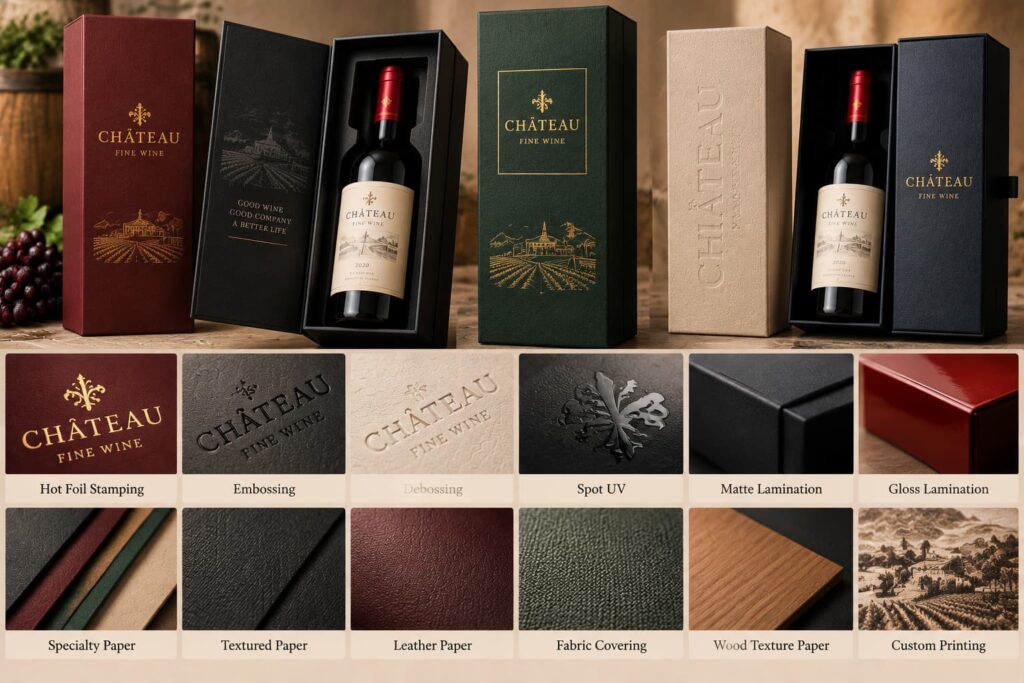
How Can Custom Wine Box Packaging Reflect Your Brand Identity?
Custom wine box packaging helps wine brands communicate their identity through materials, colors, printing, and surface finishes. Whether you are preparing premium gifts, corporate wine sets, or retail packaging, the right combination can make your packaging more recognizable and consistent with your brand.
The best design does not necessarily require the most expensive materials or the greatest number of decorative effects. Instead, it should suit your target customers, complement the wine bottle, and remain practical to produce within your budget.
1. Choose Materials That Match Your Brand Positioning
Different materials create different visual and tactile effects. Your choice should reflect the intended packaging style, required structure, and overall project budget.
| Material | Key characteristics | Potential applications |
| Rigid greyboard with wrapping paper | Firm construction with flexible exterior design options | Premium wine gift boxes |
| Coated art paper | Smooth surface for detailed printed graphics | Branded retail and promotional packaging |
| Specialty paper | Available in distinctive colors and textures | Premium gifts and limited editions |
| Textured paper | Adds tactile detail and visual depth | Minimalist or heritage-inspired brands |
| Folding carton board | Supports lightweight folding structures | Selected retail packaging applications |
Rigid greyboard provides the structure for many rigid boxes, while the wrapping paper determines much of the visible appearance. Coated paper may suit detailed artwork, whereas textured or specialty paper can create a distinctive look with simpler graphics.
Choose materials according to the packaging’s purpose, not appearance alone. Before approving a specification, request material samples and confirm that the selected paper works with the intended printing and finishing processes.
2. Select Finishing Techniques That Highlight Your Brand
Surface finishing can draw attention to a logo, add texture, or create contrast between different areas of a wine box. The most suitable technique depends on the artwork, material, desired appearance, and production budget.
Hot foil stamping: Adds a metallic or decorative foil effect to logos, lettering, and selected design elements.
Embossing and debossing: Creates raised or recessed details that add tactile interest.
Spot UV: Applies a glossy finish to selected areas to create contrast.
Matte lamination: Creates a subdued surface appearance.
Gloss lamination: Produces a more reflective finish.
These techniques can be used individually or combined when the materials and construction allow. However, adding more effects does not automatically improve the result. A well-positioned foil logo on textured paper may communicate a premium identity more effectively than several competing decorative features.
Before production, confirm the finishing areas, material compatibility, and expected appearance using an appropriate sample.
3. Maintain Consistent Logo Printing and Brand Colors
Custom wine boxes often need to coordinate with bottle labels, promotional materials, and other brand assets. Consistent logos, colors, and typography help create a unified presentation across the product range.
To reduce artwork and color discrepancies:
Provide approved logo files and current packaging artwork.
Confirm logo placement and dimensions before production.
Specify brand color references where available.
Check how colors appear on the selected paper.
Approve a representative sample when color accuracy is important.
Colors displayed on a monitor may differ from printed results because paper surfaces, printing methods, lighting, and finishing can affect their appearance. For important brand colors, reviewing the actual printed material is more reliable than relying on a digital preview alone.
Artwork should also be checked against the box structure. Logos placed too close to folds, edges, or closures may not appear as intended after assembly.
4. Match Finishes to Your Wine Brand
Different brand positions may call for different combinations of materials and finishing.
| Brand objective | Possible design direction |
| Minimalist branding | Simple graphics, restrained colors, and selective logo finishing |
| Premium wine gifts | Rigid construction, coordinated materials, and carefully chosen decorative effects |
| Corporate gifting | Consistent brand colors and clear logo placement |
| Limited-edition releases | Distinctive papers, special colors, or selected finishing details |
| Retail packaging | Recognizable graphics and a practical balance between appearance and cost |
These are starting points rather than fixed rules. A premium brand may prefer understated packaging, while a retail product may need stronger visual elements to stand out. The final decision should reflect the target audience and intended sales channel.
Discuss Custom Wine Box Packaging with LVPACK
Share your brand artwork, preferred materials, reference images, estimated order quantity, and target budget with LVPACK. These details provide a starting point for discussing suitable materials and finishing options for your custom wine box packaging project.
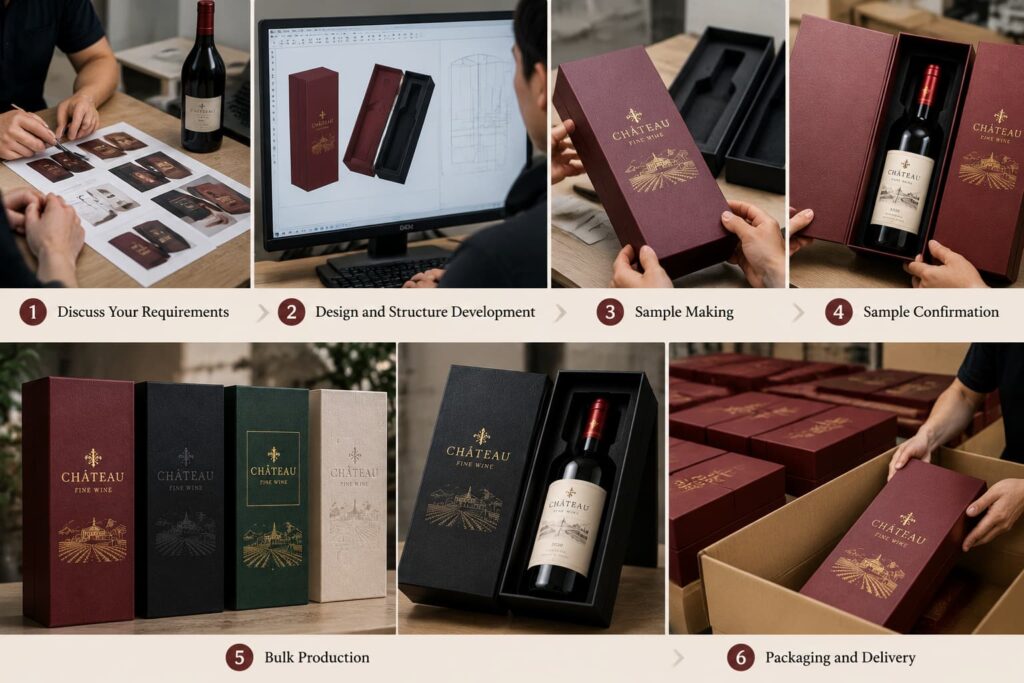
How Does Custom Wine Box Manufacturing Work from Design to Sampling?
Developing custom wine boxes involves more than preparing artwork and sending it to production. The manufacturer needs to understand the bottle dimensions, packaging requirements, design preferences, and order quantity before developing a suitable sample.
A clear development process helps buyers identify design issues early, confirm important specifications, and reduce avoidable changes before bulk production.
1. Prepare Your Bottle Specifications and Design Brief
The first step is to provide the information needed to develop the packaging. This usually includes:
Bottle dimensions: Height, diameter, and bottle shape.
Order quantity: Estimated quantity for the initial order.
Design references: Photos, sketches, or existing packaging samples.
Brand artwork: Logo files, colors, and approved graphics.
Project requirements: Intended use, target budget, and expected delivery date.
If you have not finalized the design, share your priorities and reference images first. The manufacturer can use this information to discuss possible directions before the detailed specifications are confirmed.
2. Develop the Structure and Packaging Design
Once the requirements are understood, the manufacturer can develop a proposed box structure and prepare the design for review. The design should account for the bottle dimensions, internal space, closure, artwork placement, and intended packaging use.
Before moving to sampling, confirm the key specifications, including the overall dimensions, materials, branding details, and any required accessories.
Confirming these details early helps reduce misunderstandings and unnecessary revisions later.
3. Review and Approve the Sample
A sample allows you to assess the proposed design before committing to bulk production. Depending on the project, it may be used to review the dimensions, appearance, assembly, and fit of the bottle.
When reviewing the sample, check:
Whether the bottle fits as intended.
Whether the box opens and closes properly.
Whether the artwork and logo placement are correct.
Whether the materials and finishes match the approved specifications.
Whether any changes are required before production.
If revisions are necessary, communicate them clearly and confirm the updated specifications before approving the final sample.
4. Confirm Production Requirements Before Bulk Ordering
After the sample is approved, confirm the final artwork, materials, finishing details, order quantity, and delivery requirements. These details provide a reference for the production team and help maintain consistency between the approved sample and the finished order.
Changes made after approval may affect cost or timing, so it is best to settle important decisions before production begins.
Start Your Custom Wine Box Project with LVPACK
Share your bottle dimensions, design references, estimated quantity, and delivery requirements with LVPACK to discuss your project and the next steps for design and sampling.
How Much Do Custom Wine Boxes Cost?
The cost of custom wine boxes depends on the box structure, dimensions, materials, finishing requirements, order quantity, and packaging specifications. Two boxes designed for similar wine bottles can have different prices if one uses a more complex structure, additional inserts, or multiple finishing processes.
For wineries, distributors, and corporate gifting buyers, the best way to manage packaging costs is to define the essential requirements before requesting a quotation. This helps the manufacturer recommend a suitable solution without adding features that provide little practical value.
1. What Factors Affect Custom Wine Box Prices?
The main cost factors include:
Box dimensions and structure: Larger boxes and more complex constructions may require additional materials and production steps.
Materials: Board grade, wrapping paper, and specialty materials influence material costs.
Printing and finishing: Foil stamping, embossing, lamination, and other custom effects may add setup and processing costs.
Inserts and dividers: Custom internal components affect material usage and assembly.
Order quantity: The quantity ordered influences how setup costs are distributed across individual boxes.
Packing and delivery: Outer cartons, packing requirements, and shipping arrangements can affect the total project budget.
The final quotation should reflect the complete packaging specification rather than the box exterior alone.
2. How Does Order Quantity Affect Unit Cost?
Order quantity can influence the unit price because some setup and preparation costs are spread across the production run. Larger orders may therefore achieve a lower unit cost, although the actual result depends on the design, materials, production process, and supplier’s pricing structure.
Smaller orders may offer greater flexibility when testing a new product or launching a limited edition, but the unit price can be higher.
When comparing quotations, consider both the unit price and total order value. A lower unit price may still require a larger initial investment or create additional inventory costs.
3. How Can You Control Packaging Costs Without Compromising Quality?
Cost control does not necessarily mean choosing the cheapest materials. It means identifying which features matter most to your product and avoiding unnecessary complexity.
Consider these approaches:
Choose dimensions that fit the bottle without excessive unused space.
Prioritize finishing effects that contribute directly to brand presentation.
Compare suitable material options before finalizing the design.
Avoid unnecessary structural features that do not improve functionality.
Confirm the specifications before approving the production sample.
For example, a premium wine gift may justify a more elaborate presentation, while a high-volume promotional project may benefit from a simpler design that is easier to produce consistently.
The right balance depends on your target market, product positioning, and order quantity.
4. What Should You Include in a Wine Box Quotation Request?
Providing complete project information helps the manufacturer prepare a more relevant quotation.
| Information | Why it matters |
| Bottle dimensions and quantity per box | Determines the required internal space |
| Preferred box structure | Establishes the construction requirements |
| Estimated order quantity | Helps calculate production pricing |
| Artwork and finishing requirements | Defines printing and customization needs |
| Insert and accessory requirements | Clarifies internal components |
| Delivery destination and target date | Helps assess shipping and scheduling requirements |
If you have not selected a final design, provide your bottle dimensions, reference images, estimated order quantity, and target budget. The manufacturer can then discuss suitable options before the specification is finalized.
Request a Custom Wine Box Quote from LVPACK
Share your packaging requirements and estimated order quantity with LVPACK to discuss a suitable design and quotation. The more clearly you define your project, the easier it is to evaluate packaging options against your budget.
What Can You Expect from a Custom Wine Box Manufacturer Like LVPACK?
Choosing a custom wine box manufacturer involves more than comparing product photos and quotations. Buyers also need to understand how the supplier handles design requirements, sample development, production specifications, and communication throughout the project.
For wine brands, distributors, and corporate gifting businesses, clear coordination helps reduce misunderstandings and keeps packaging decisions aligned with the product, budget, and delivery schedule.
LVPACK supports custom packaging projects by working with customers to clarify their requirements, discuss suitable packaging options, and coordinate the development process from initial specifications to production preparation.
1. Custom Packaging Development Based on Your Requirements
Every wine packaging project has its own requirements. Bottle dimensions, brand positioning, intended use, and order quantity all influence the final specification.
Providing these details at the beginning helps establish a clearer development direction. Reference images, existing packaging samples, and brand artwork can also help communicate your expectations.
Rather than selecting a design based on appearance alone, discuss the practical requirements that matter to your project, including bottle fit, presentation, materials, and budget.
2. Sample Review Before Bulk Production
A sample provides an opportunity to review the proposed packaging before committing to a production order. Buyers can check the dimensions, appearance, assembly, and compatibility with the intended bottle.
Before approving the sample, confirm that the important specifications match your requirements. If changes are needed, document them clearly and review the updated version before production.
Clear sample approval helps establish a shared reference for the finished packaging.
3. Production Coordination and Quality Requirements
Once the specifications are confirmed, production needs to follow the approved design, materials, and finishing requirements. Clear communication is particularly important when a project involves multiple components or several packaging variations.
Before placing an order, discuss the inspection requirements, packing arrangements, delivery schedule, and how approved specifications will be referenced for future orders.
For repeat purchases, retaining the approved artwork and key product specifications can help simplify communication and support consistency between production runs.
4. Information to Share with LVPACK
To start a custom wine box project, prepare the following information:
Bottle dimensions and bottle quantity per box.
Preferred box style or reference images.
Logo artwork and branding requirements.
Estimated order quantity.
Target budget and delivery date.
Any special requirements for inserts, accessories, or shipping packaging.
If you have not finalized every detail, share the information available and explain your priorities. This provides a starting point for discussing suitable packaging options.
Discuss Your Custom Wine Box Project with LVPACK
Contact LVPACK with your bottle specifications, design references, and estimated order quantity to discuss your requirements and the next steps for custom packaging development.
How Can You Order Custom Wine Boxes Wholesale from LVPACK?
Ordering custom wine boxes wholesale starts with defining your packaging requirements and confirming the details that affect production and pricing. Whether you are purchasing wine gift boxes for retail, corporate gifting, or a new product launch, providing clear specifications helps the manufacturer assess your project and recommend suitable options.
LVPACK works with customers on custom packaging requirements. Sharing your bottle dimensions, preferred design, estimated order quantity, and target delivery date provides a practical starting point for discussing your project.
1. Confirm Your Order Quantity and MOQ
Before requesting a quotation, estimate how many boxes you need for your initial order and whether you expect repeat purchases.
The minimum order quantity (MOQ) may depend on the box structure, materials, customization requirements, and production arrangements. Confirm the applicable MOQ directly with LVPACK rather than assuming that every wine box design has the same minimum.
When planning your order, consider:
Your initial sales or gifting requirements.
Expected demand for future orders.
The cost implications of different order quantities.
Storage space for finished packaging.
Whether several product variations are required.
Choosing an appropriate quantity helps balance the initial investment against your packaging needs.
2. Confirm Sampling and Production Lead Times
Sampling and bulk production are separate stages of a custom packaging project. The schedule can depend on design readiness, material availability, structural complexity, finishing requirements, and sample approval.
Before placing an order, ask LVPACK to confirm:
The expected sample development time.
Whether design revisions are required.
The estimated bulk production lead time.
When the final artwork and specifications must be approved.
The expected dispatch date and shipping arrangements.
Confirm the schedule against your actual launch or delivery deadline. If your wine boxes are intended for a holiday campaign, corporate event, or product launch, allow time for sample review, revisions, production, and transportation.
Specific MOQ and lead-time commitments should be confirmed for your project.
3. Prepare the Information Needed for a Quotation
A clear inquiry helps the manufacturer understand the scope of the project and prepare a relevant quotation.
Custom Wine Box Wholesale Inquiry Checklist
Bottle dimensions and bottle quantity per box.
Preferred box style or reference images.
Estimated order quantity.
Logo artwork and branding requirements.
Preferred materials and finishing options, if known.
Additional inserts or gift accessories.
Delivery destination and required delivery date.
Target budget, if available.
You do not need to finalize every detail before making an inquiry. If you have a bottle sample, a reference image, and an estimated quantity, you can start the discussion and clarify the remaining specifications with the manufacturer.
4. Request a Quote from LVPACK
Once your basic requirements are ready, contact LVPACK to discuss the next steps for your custom wine box project.
Include your bottle specifications, estimated quantity, design references, and intended use. If you are unsure which structure or materials are suitable, explain your priorities so the available options can be assessed against your requirements and budget.
Before approving the order, confirm the final specifications, quotation, sample approval status, production schedule, and delivery arrangements.
Ready to order custom wine boxes wholesale?
Contact LVPACK with your project details to discuss your requirements and request a quotation for your custom wine box packaging.