Custom Honeycomb Boxes for Protective Packaging and Shipping


What Are Custom Honeycomb Boxes Used for in Protective Packaging and Shipping?
When products are heavy, bulky, fragile, or difficult to pack, standard shipping cartons may not provide the right balance of protection, weight, and cost. Custom honeycomb boxes offer an alternative for businesses that need lightweight packaging with a rigid cellular structure designed around their products and shipping conditions.
Made from paper honeycomb board, these boxes can be customized for industrial components, furniture, appliances, machinery parts, and other goods that require reliable protection during handling and transportation. The right design depends on more than box dimensions. Product weight, stacking loads, moisture exposure, handling conditions, and internal movement all affect how the packaging should be constructed.
What Makes Honeycomb Boxes Different?
Honeycomb board consists of a cellular paper core bonded between facing sheets. This structure creates a lightweight panel with useful stiffness and load-bearing potential. When properly designed and manufactured, it can help protect products while reducing unnecessary packaging weight.
Key benefits include:
Lightweight structural protection for products that need rigid outer panels.
Custom dimensions and configurations designed around individual products.
Internal partitions, inserts, and reinforced corners to limit movement.
Flat-pack options that may reduce storage requirements before assembly.
Paper-based material options that may support recycling where suitable facilities exist.
Actual performance depends on the core structure, paper grade, bonding quality, panel thickness, and overall box design. Honeycomb packaging is not automatically waterproof, crush-proof, or suitable for every heavy-load application. The specification must match the product and the conditions it will face during storage, handling, and transportation.
Which Products Can Be Packed in Custom Honeycomb Boxes?
| Product or industry | Typical packaging requirement | Possible custom solution |
| Furniture and furniture components | Protection for edges, panels, and corners | Reinforced cartons with corner protection |
| Appliances and electrical equipment | Reduced movement during handling | Custom partitions and protective inserts |
| Machinery parts and industrial components | Support for heavier loads and irregular shapes | Reinforced boxes with tailored internal supports |
| Glass, ceramics, and fragile products | Separation and reduced direct contact | Custom compartments and cushioning |
| Large or bulky products | Rigid packaging and palletized handling | Oversized or pallet-integrated packaging |
| Export cargo | Protection during loading, transit, and unloading | Packaging designed around shipping conditions |
These are starting points rather than universal specifications. Glass products may need carefully positioned cushioning rather than simply a thicker outer box. Heavy metal components may require a reinforced base designed around their actual load-bearing points.
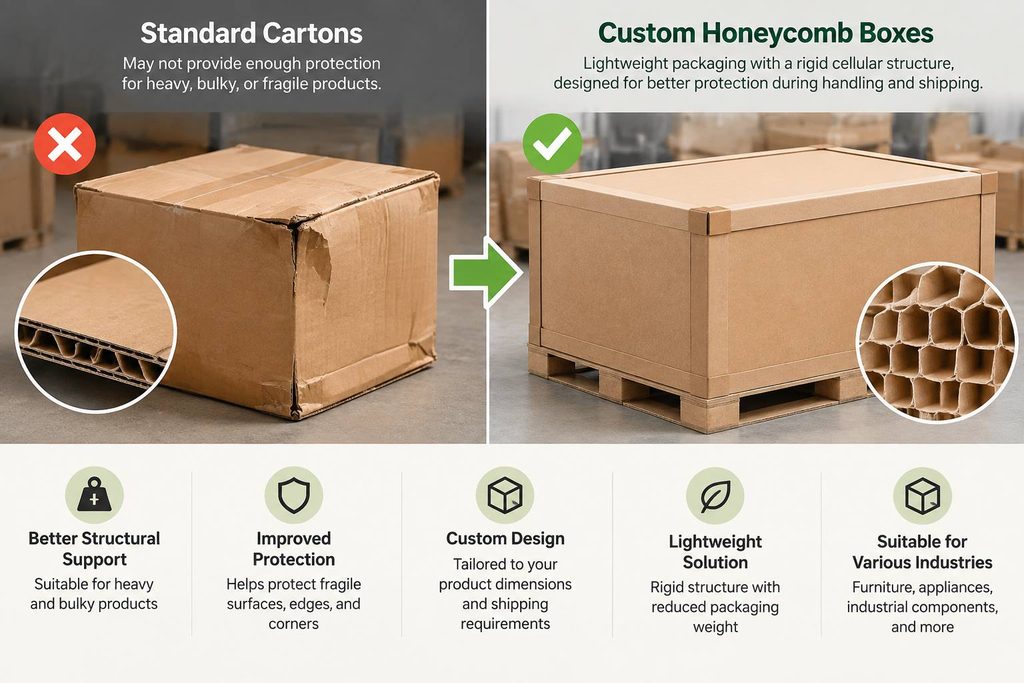
When Should You Consider Honeycomb Boxes Instead of Standard Cartons?
Honeycomb boxes are worth evaluating when existing packaging is too flexible, requires substantial reinforcement, or does not provide enough internal support.
They may be suitable when you need to:
Improve structural support for heavy or bulky products.
Protect corners, edges, and large flat surfaces.
Accommodate non-standard product dimensions.
Combine an outer box with custom inserts or pallet components.
Reduce unnecessary packaging weight without compromising required protection.
Conventional corrugated cartons may remain more economical for lightweight products and standard parcel shipments. The best choice depends on the required protection, total packaging cost, shipping conditions, and product value—not material thickness alone.
For a broader comparison of paper-based packaging options, explore our packaging material selection guide.
How to Customize Honeycomb Boxes for Different Products and Shipping Requirements
A successful custom honeycomb box starts with the product, not a standard box size. The packaging should accommodate the product’s shape, weight, vulnerable areas, handling requirements, and shipping route.
Before choosing a design, consider what the box must protect against. A product may need support against stacking pressure, protection from edge impacts, separation between components, or a base that distributes its weight evenly. Each requirement can influence the box structure and internal fitments.
What Information Is Needed to Design a Custom Honeycomb Box?
Start by preparing the following details:
Product length, width, height, and weight.
Required internal box dimensions and maximum external dimensions.
Fragile surfaces, projecting parts, and vulnerable corners.
Stacking height and expected load during storage or transportation.
Shipping method, handling conditions, and expected transit duration.
Order quantity and expected repeat-order volume.
Requirements for partitions, inserts, printing, labels, or pallet integration.
Accurate information helps reduce unnecessary design revisions. If dimensions or shipping conditions are uncertain, identify the assumptions before approving the final structure.
How Do Product Weight and Shape Affect Box Design?
Product weight influences the required support structure, but weight alone does not determine the right box. The way a product distributes its load can be equally important.
A compact metal component may place concentrated pressure on a small area, while a large flat panel may need support across a wider surface. Irregularly shaped products may require custom inserts to prevent movement or contact with the outer walls.
The design should consider:
Where the product’s weight rests on the box.
Whether the base needs additional reinforcement.
How internal supports prevent movement.
Whether the product can shift during lifting or transport.
How the packaging will behave when several boxes are stacked.
Which Custom Features Can Improve Product Protection?
Depending on the application, a custom honeycomb box may incorporate reinforced corners, internal partitions, cushioning, protective sleeves, or a pallet-compatible base.
The purpose of these features is to address specific risks rather than add material indiscriminately. For example, a divider can separate multiple components, while a reinforced base can help distribute a concentrated load. The right combination depends on the product and the transport environment.
For projects that require a tailored structure, custom packaging design can help connect product dimensions, protection requirements, and packaging configuration. The proposed design should be confirmed through drawings and physical samples before mass production.
Honeycomb Box Materials, Board Thickness, and Custom Structural Options
The performance of a honeycomb box depends on its complete construction. Choosing a board based only on thickness can lead to unnecessary cost or inadequate protection because core geometry, facing paper, bonding, panel dimensions, and reinforcement all influence structural behavior.
How Do Honeycomb Core and Facing Sheets Affect Performance?
The honeycomb core creates the cellular structure, while the facing sheets and bonding help form a rigid panel. Their combined properties determine how the board responds to loads and handling.
When comparing material options, ask the supplier to specify:
Core construction and relevant dimensions.
Facing paper grade and panel thickness.
Bonding method and quality-control requirements.
Reinforcement in high-stress areas.
Any material or performance limitations.
The appropriate specification should be based on the intended load, product geometry, and transport conditions. A thicker board is not automatically the best choice if the design does not distribute the load effectively.
Should You Choose Honeycomb Board or Corrugated Cardboard?
Honeycomb board can be useful for larger panels, protective structures, and applications requiring a rigid cellular construction. Corrugated cardboard is widely used for shipping cartons and may be more economical for many lightweight products.
| Consideration | Honeycomb board | Corrugated cardboard |
| Structure | Cellular core between facing sheets | Fluted paper between liners |
| Typical applications | Protective panels, bulky goods, selected heavy-duty packaging | General shipping cartons and parcel packaging |
| Design priorities | Core geometry, panel construction, load distribution | Flute profile, board grade, carton construction |
| Potential advantage | Lightweight rigidity for suitable applications | Flexible converting options and widespread availability |
| Main consideration | Requires suitable structural design and bonding | Must be specified correctly for the required load and handling |
The choice should reflect product protection, total cost, availability, and shipping conditions. In some applications, a combination of corrugated cartons and honeycomb inserts may provide a practical balance.
For a project-specific recommendation, compare the materials against the same performance requirements rather than relying on general claims about either option.
What About Moisture and Recyclability?
Paper honeycomb materials can be affected by moisture, depending on the paper grade, adhesive system, surface treatment, and exposure conditions. If packaging will be stored in humid warehouses or transported through changing climates, discuss these risks before selecting the board.
Paper-based packaging may be recyclable where suitable collection and processing facilities exist. However, recyclability depends on local infrastructure and the materials used in the finished package, including coatings, adhesives, and attached components.
Custom Honeycomb Box Manufacturing Process: Cutting, Bonding, and Assembly
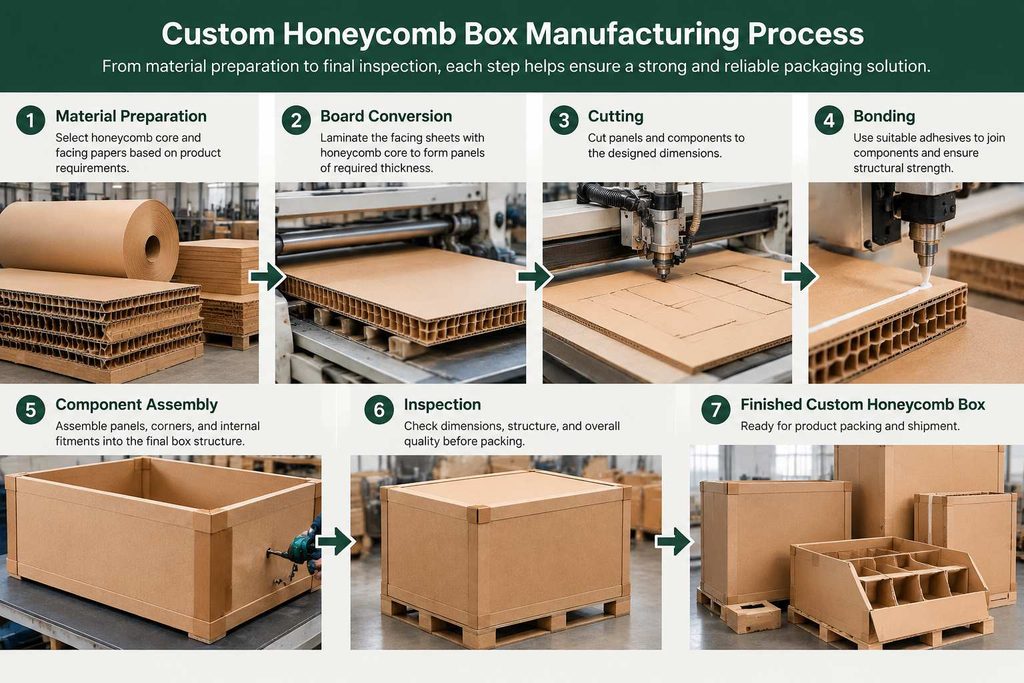
Custom manufacturing turns a packaging specification into a physical box that fits the product and performs under expected shipping conditions. The exact process varies by factory and design, but it commonly involves material preparation, board conversion, cutting, bonding, component assembly, and inspection.
How Are Custom Honeycomb Boxes Made?
A typical production sequence includes:
Specification review: Confirm dimensions, product weight, protection requirements, and shipping conditions.
Structural design: Determine the box configuration, panel layout, reinforcement, and internal fitments.
Material preparation: Select suitable honeycomb board and facing materials.
Cutting and conversion: Process panels and components to the approved dimensions.
Bonding and assembly: Join components and form the required packaging structure.
Sample approval: Check fit, assembly, dimensions, and required performance.
Mass production and inspection: Manufacture the approved design and verify agreed quality criteria.
Not every supplier performs every operation in-house. If the project requires specialized processes, clarify which stages are handled at the production site and which are subcontracted.
Which Manufacturing Details Should Buyers Check?
Cutting accuracy affects how panels fit together. Bonding quality influences the integrity of the board and assembled structure. Assembly consistency helps ensure that production units match the approved sample.
Ask the manufacturer how it controls critical dimensions, verifies materials, records production changes, and inspects finished products. For complex packaging, request drawings that identify panel sizes, fitments, reinforcement, and assembly requirements.
A clear specification reduces ambiguity between the buyer and manufacturer. It also makes repeat orders easier because the approved construction can be reproduced against a documented reference.
Honeycomb Box Strength and Quality Testing for Safe Product Shipping
Packaging quality should be evaluated against the risks the product will encounter, not appearance alone. A box may look well made but still be unsuitable if its base, joints, or internal supports cannot withstand the intended loads.
Which Tests May Be Needed?
The appropriate tests depend on product value, weight, fragility, shipping conditions, and customer requirements. Possible evaluations include:
Dimensional inspection: Confirms that the box and components meet the approved drawings.
Compression or stacking tests: Evaluates performance under specified loading conditions.
Drop or impact tests: Assesses how the package responds to defined handling impacts.
Vibration or transit simulation: Helps evaluate risks associated with transportation.
Bonding and assembly checks: Identifies visible separation, weak joints, or assembly inconsistencies.
Moisture conditioning: May be relevant when humidity is a significant risk.
These tests are not required for every project. Agree on the relevant methods, conditions, and acceptance criteria before sampling or production. A test result is meaningful only when its method and conditions are understood.
How Can You Maintain Consistent Quality Across Orders?
Use the approved drawing, material specification, and sample as the production reference. Record critical dimensions, board construction, internal components, and acceptable tolerances.
For repeat orders, ask the supplier to maintain version-controlled specifications and notify you before making changes to materials or construction. Any change that could affect performance should be reviewed and approved before implementation.
For larger or higher-risk shipments, an agreed inspection plan or independent pre-shipment inspection may provide additional confidence. The goal is not to add unnecessary checks, but to focus inspection effort on the features most likely to affect product protection.
Custom Honeycomb Box Price: What Affects Your Packaging Cost?
The price of a custom honeycomb box depends on the design and commercial requirements. Dimensions, board construction, material grade, internal fitments, order quantity, tooling, inspection, and delivery terms can all affect the final quotation.
What Are the Main Cost Factors?
| Cost factor | How it affects the quotation |
| Box dimensions | Larger panels generally require more material |
| Board construction | Core geometry, paper grade, and thickness affect material use and performance |
| Structural complexity | Special cuts, partitions, reinforcement, and assembly can add processing costs |
| Order quantity | Larger production runs may spread setup costs across more units |
| Sampling and tooling | Prototypes or dedicated cutting tools may involve initial charges |
| Quality requirements | Additional testing and inspection may increase project costs |
| Delivery terms | Transport, export handling, freight, and destination charges affect total cost |
A lower unit price does not necessarily represent better value if it excludes necessary protection, inspection, or delivery costs. Compare quotations using the same specifications, order quantity, and delivery destination.
How Does MOQ Affect the Unit Price?
Minimum order quantity depends on the product design, production setup, material purchasing requirements, and manufacturing batch. A relatively simple carton may have different minimums from a highly customized structure requiring dedicated tooling or special components.
Ask each supplier to confirm the MOQ for the exact design rather than relying on a general company-wide figure. For ongoing programs, compare the initial order with anticipated repeat orders and consider the cost of maintaining consistent specifications.
How Should You Compare Total Delivered Cost?
A complete cost comparison may include samples, tooling, packaging accessories, inspection, export packing, inland transport, international freight, insurance, duties, and destination charges, where applicable.
Make sure quotations state the applicable delivery terms and identify excluded costs. Comparing the total cost of delivering the same approved packaging to the same destination gives a more reliable basis for purchasing decisions.
Custom Honeycomb Box Samples, Lead Times, and Mass Production
Sampling allows buyers to confirm whether the proposed structure works before committing to a full production run. It also provides an opportunity to check dimensions, assembly, product fit, and any critical protective features.
What Should You Check When Approving a Sample?
Compare the sample with the agreed specification. Check the internal dimensions, material construction, panel thickness, joints, reinforcement, fitments, and assembly method.
Where protection performance is critical, agree on suitable tests before approving the sample. A visual inspection alone may not establish whether the package can withstand stacking pressure, impact, or transportation-related vibration.
Keep a record of the approved sample and its corresponding drawing. This provides a reference for mass-production inspection and future repeat orders.
How Long Does Custom Honeycomb Box Production Take?
Lead time depends on design complexity, tooling, material availability, sample revisions, order quantity, factory capacity, and shipping arrangements. There is no universal production timeline that applies to every custom project.
Ask the supplier to separate the schedule into design, sample preparation, approval, material procurement, mass production, inspection, and dispatch. Confirm when the production lead time begins and whether it excludes customer approval and international transit.
Providing complete specifications early can help reduce unnecessary revisions and improve schedule planning.
How Can You Prepare for Repeat Orders?
For recurring orders, retain the approved drawings, sample references, material specifications, and inspection criteria. Confirm whether the supplier can reproduce the same construction and how it manages authorized changes.
Forecasts and advance notice can help suppliers plan materials and production capacity. However, delivery commitments should always be confirmed against current availability and the actual order requirements.
Request a Custom Honeycomb Box Quote: What Specifications Do You Need?
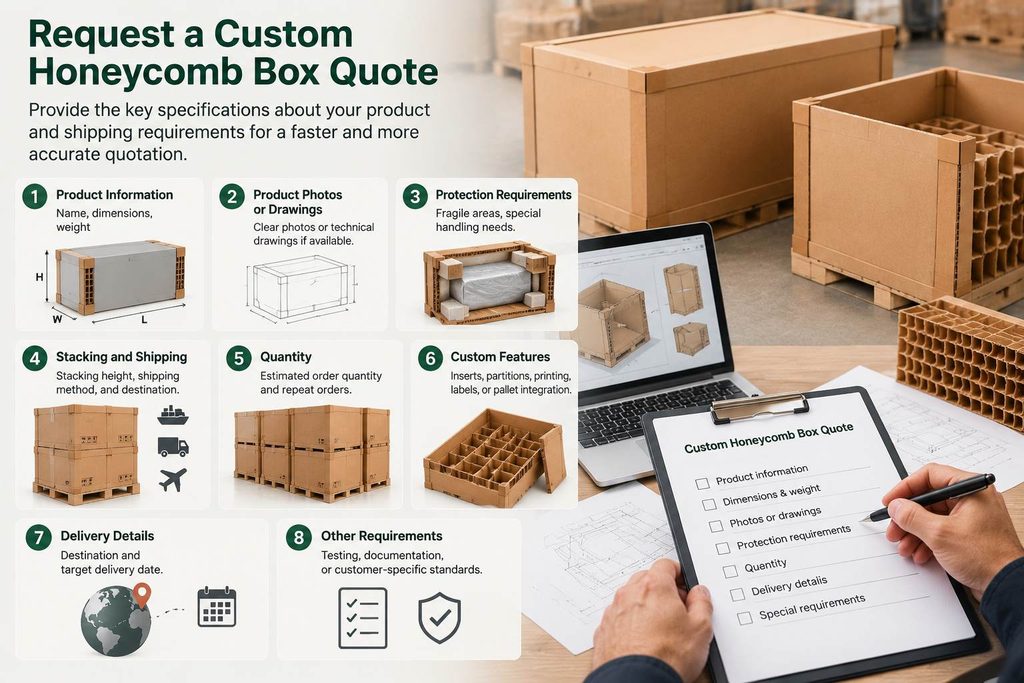
A useful quotation starts with clear product information. The more accurately you describe the product and its shipping conditions, the easier it is to assess the packaging requirements and compare suitable proposals.
What Information Should You Include in Your Inquiry?
Prepare the following information where available:
Product name, dimensions, and weight.
Required internal dimensions or maximum external box size.
Product photos, drawings, or reference packaging.
Fragile areas and protection requirements.
Stacking conditions and shipping method.
Estimated order quantity and expected repeat-order volume.
Required inserts, partitions, printing, labels, or pallet integration.
Destination and target delivery date.
Any testing, documentation, or customer-specific requirements.
If some details are not yet available, identify them as provisional. A preliminary discussion can help establish which specifications need to be confirmed before final pricing and production approval.
What Happens After You Submit the Requirements?
The next steps typically involve reviewing the application, clarifying technical details, proposing a suitable structure, preparing a quotation, and arranging a sample where necessary.
Before approving production, confirm the final drawing, material construction, commercial terms, delivery schedule, and quality acceptance criteria. This helps ensure that the quoted packaging corresponds to the product and performance requirements you actually need.
If your project requires a different type of protective packaging, industrial packaging solutions may provide a useful starting point for exploring alternative configurations.
Custom Honeycomb Boxes FAQ: MOQ, Materials, Samples, and Shipping
Are honeycomb boxes suitable for heavy products?
They can be suitable when the board construction, base, joints, and internal support are designed for the product’s actual load. Confirm the expected loading conditions and test requirements before selecting a structure.
Can honeycomb boxes be made to custom dimensions?
Custom dimensions are possible when the manufacturer has the necessary design and processing capabilities. Provide accurate product measurements, required internal clearance, and any dimensional restrictions.
Are honeycomb boxes waterproof?
Paper honeycomb boxes should not be assumed to be waterproof. Moisture resistance depends on the materials, adhesives, treatments, and exposure conditions. Discuss humidity and water exposure before approving the specification.
What is the minimum order quantity?
MOQ varies by design, materials, tooling, and production setup. Request confirmation for the specific box configuration and quantity you need.
Can I request a sample before mass production?
Sampling is a practical way to verify dimensions, assembly, and product fit. For demanding applications, agree on performance tests and acceptance criteria before approving the sample.
What information is needed for a quotation?
The most useful starting information includes product dimensions, weight, quantity, shipping conditions, protection requirements, and any requested custom features. Drawings or photos can help clarify the application.
How can I reduce packaging costs without sacrificing protection?
Review the complete design rather than reducing board thickness alone. Appropriate dimensions, better load distribution, fewer unnecessary components, and optimized packing arrangements may help control costs. Any cost-saving change should be checked against the required performance criteria.
How do I start a custom honeycomb box project?
Prepare the product details, quantity, shipping requirements, and any reference drawings or photos. These details provide a practical starting point for evaluating the packaging structure, sampling requirements, and quotation.