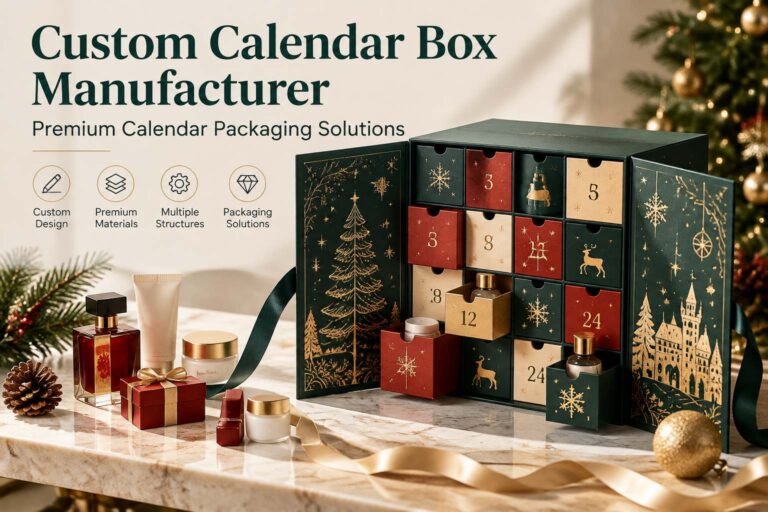
Custom 25 Days of Christmas Boxes – Create a Memorable Holiday Experience for Your Brand

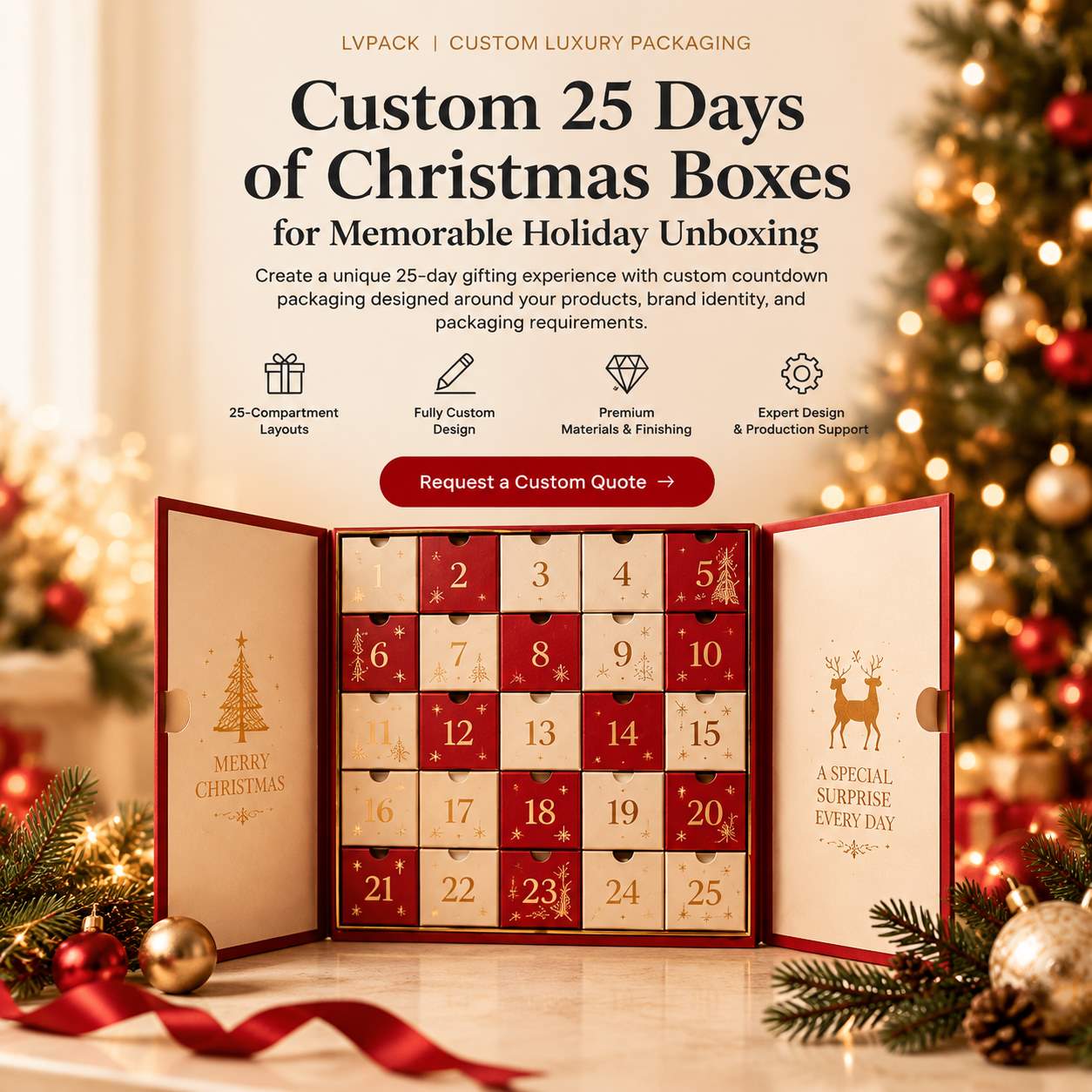
A well-designed Christmas countdown box does something that ordinary gift packaging cannot: it gives customers a reason to interact with your brand every day. Instead of receiving all their gifts at once, customers discover a new product, surprise, or special detail each day throughout the countdown. This simple idea turns a seasonal gift into an engaging brand experience that can last for 25 days.
For beauty brands, a 25-day Christmas box can introduce a complete skincare routine or a collection of bestselling cosmetics. For fragrance companies, it can showcase miniature perfumes and scent discovery sets. Chocolate brands can use individual compartments to create a daily tasting experience, while premium lifestyle brands can combine accessories, collectibles, and seasonal gifts in one presentation.
However, creating a successful 25 Days of Christmas box involves much more than printing a festive design on a rigid box. The packaging must accommodate 25 products, sometimes in different shapes, sizes, and weights. Every compartment needs to be considered, the internal layout must make efficient use of available space, and the finished box should be practical to open, display, store, and transport.
An attractive exterior means little if the products inside do not fit properly or customers struggle to remove them.
LVPACK develops custom packaging solutions for brands looking to create distinctive Christmas countdown boxes. With packaging design, structural development, material selection, sampling, and production support, we help turn packaging concepts into practical products that reflect your brand identity and product requirements.
Whether you are planning a luxury beauty advent calendar, a perfume discovery collection, a premium chocolate gift set, or a corporate Christmas gift, the right packaging starts with understanding what goes inside.
1. Custom 25 Days of Christmas Boxes Designed Around Your Brand
A custom 25 Days of Christmas box should reflect more than the festive season. It should communicate your brand personality, present your products beautifully, and create an experience that customers associate with your business.
Unlike standard gift packaging, a Christmas countdown box needs to accommodate multiple products within one coordinated structure. This means the design must consider the relationship between the exterior presentation, internal compartments, product arrangement, and daily opening experience.
Create a Christmas Countdown Box That Reflects Your Brand Identity
Every brand has its own visual language. A luxury skincare company may prefer a minimalist design with elegant typography and subtle metallic details. A playful beauty brand may choose brighter colors, illustrated graphics, and individually numbered compartments. A premium chocolate brand may prefer traditional Christmas colors and a more classic gift presentation.
Your custom Christmas packaging can be developed around different brand elements:
Brand colors: Use your existing brand palette or develop a seasonal color combination for your Christmas collection.
Logo presentation: Incorporate your logo into the exterior packaging and selected internal elements.
Custom graphics: Apply illustrations, patterns, seasonal artwork, and product-related imagery.
Numbered compartments: Create a clear visual sequence for the 25 daily surprises.
Personalized messages: Add greeting cards, product information cards, or small messages to improve the customer experience.
Premium appearance: Select suitable paper materials, textures, and finishing details to support your brand positioning.
The objective is to make the countdown box feel like a complete brand product rather than a collection of unrelated items placed inside one container.
Custom Packaging for Different Christmas Gift Collections
A 25-day countdown box can serve several commercial purposes.
For a beauty brand, it may become a limited-edition holiday collection that introduces customers to different products. For a perfume company, it can encourage customers to explore a wider fragrance range. For an online retailer, it can become a seasonal gift set that combines popular products in one attractive package.
The packaging should therefore be designed according to the products, target audience, retail positioning, and intended use.
LVPACK supports brands, designers, wholesalers, and packaging buyers with customized packaging development and manufacturing services. Whether you have a finished design, a reference image, or only an initial idea, your packaging requirements can be evaluated before the structure and materials are finalized.
2. How to Design a 25-Day Christmas Countdown Box for 25 Different Products
One of the biggest challenges when developing a 25-day Christmas countdown box is arranging 25 products inside a single package without wasting space or compromising product protection.
The challenge becomes more complicated when the products have different dimensions. A collection containing miniature perfume bottles, skincare tubes, cream jars, and accessories cannot always use identical compartment sizes.
A successful design needs to balance product dimensions, compartment arrangement, overall box size, accessibility, and shipping requirements.
Start With a Complete Product List and Dimensions
Before developing the structure, prepare a list of all 25 products.
For each product, the following information is useful:
| Product information | Why it matters |
| Length, width, and height | Determines the required compartment dimensions |
| Product weight | Helps evaluate structural support |
| Product shape | Influences the insert design |
| Fragility | Determines the level of protection needed |
| Individual packaging | Affects the actual space required |
| Opening requirements | Determines how easily the product can be removed |
It is important to measure products in their actual retail packaging rather than relying only on the dimensions of the products themselves.
For example, a miniature perfume bottle may appear small, but its glass container, cap, and individual carton can require considerably more space than expected.
Similarly, skincare products may include different packaging formats, such as tubes, jars, bottles, and boxes. Each format creates different requirements for compartment depth and internal positioning.
Plan the 25 Compartments According to Product Size
Not every compartment needs to have the same dimensions.
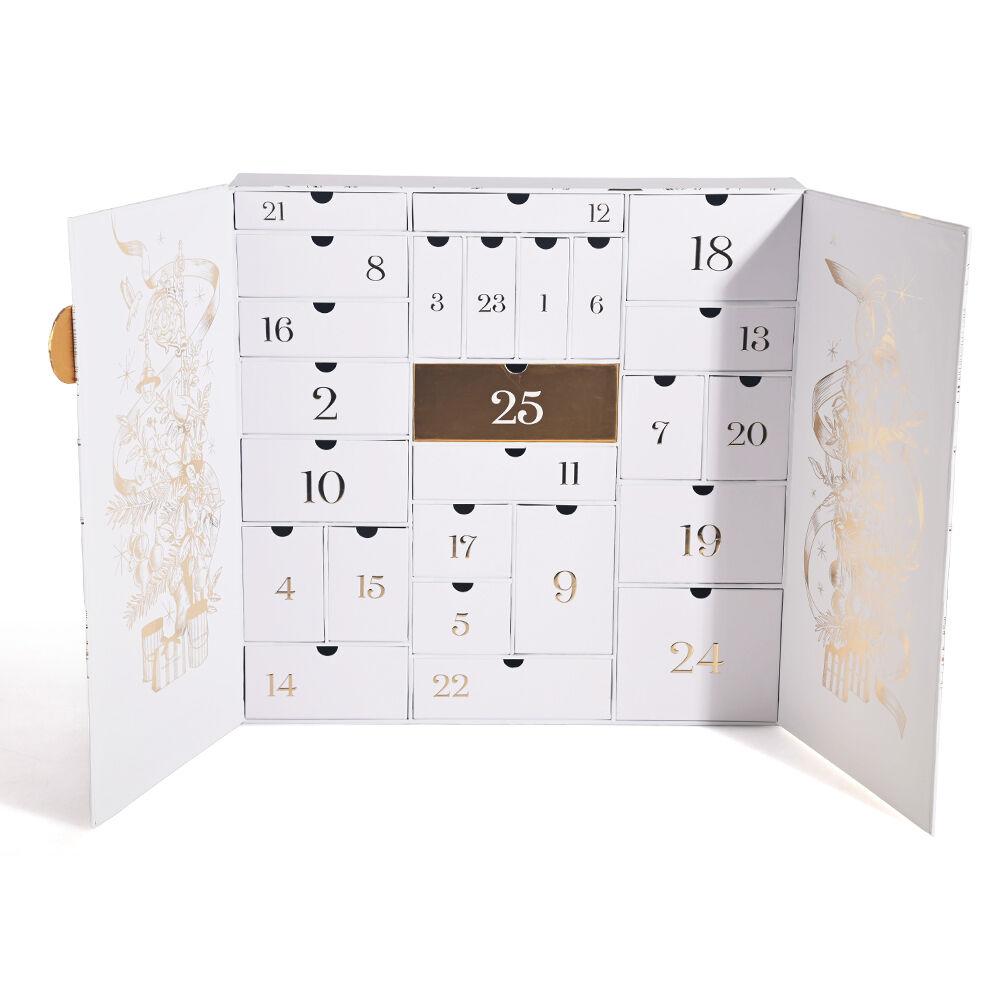
A practical 25-compartment layout can combine different compartment sizes according to the product collection.
For example:
Larger compartments can accommodate skincare jars, perfume bottles, or gift items.
Narrow compartments can hold miniature tubes, small accessories, or individual products.
Deeper compartments can accommodate taller products.
Smaller compartments can be reserved for samples, cards, or lightweight accessories.
The arrangement should also consider how customers will access each compartment.
If a product is difficult to remove because the opening is too narrow or the surrounding compartments restrict movement, the daily opening experience becomes frustrating.
This is why the internal dimensions should be evaluated together with the actual opening method.
Balance Internal Capacity and External Box Dimensions
A common design mistake is increasing the overall size of a countdown box simply to accommodate all 25 products.
A larger box may provide more internal space, but it can also increase material consumption, storage requirements, and transportation volume.
A more practical approach is to evaluate:
The actual dimensions of all products.
The minimum practical space required for each compartment.
The thickness and construction of internal dividers.
The overall structural dimensions.
The available space for protective inserts.
The final shipping dimensions.
For brands selling internationally, packaging dimensions deserve particular attention because shipping charges can be affected by dimensional weight as well as actual product weight.
The best design is not necessarily the largest box. It is the one that accommodates the product collection while maintaining a good balance between appearance, functionality, and logistics.
3. Custom Christmas Advent Calendar Box Structures and Design Options
The structure of a Christmas advent calendar box determines how the products are arranged, how customers open each compartment, and how the package looks when displayed.
Different structures create different experiences. Some emphasize the surprise of opening individual drawers, while others provide a larger presentation area or a more compact format.
Choosing the right structure depends on product dimensions, brand positioning, production requirements, and transportation considerations.
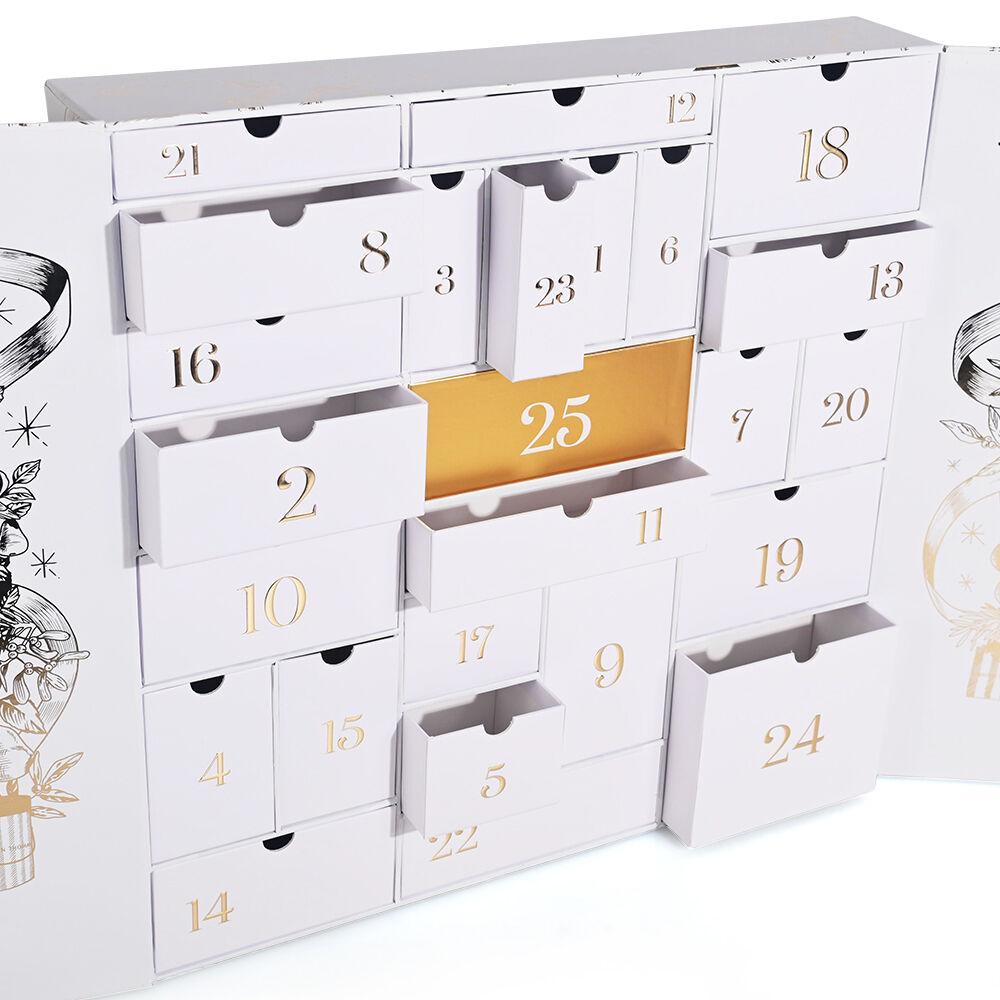
Drawer-Style Christmas Advent Calendar Boxes
Drawer-style structures are popular for countdown packaging because each product can be placed in an individual drawer.
Each drawer can have its own number, allowing customers to follow the daily countdown.
This structure is particularly suitable for:
Miniature perfume collections.
Skincare discovery sets.
Beauty accessories.
Small lifestyle gifts.
Individually packaged confectionery.
The main design considerations include drawer dimensions, opening clearance, internal support, and the relationship between the drawer arrangement and the exterior structure.
A well-designed drawer box should allow customers to open and close individual drawers without unnecessary resistance.
For a 25-day collection, the arrangement also needs to consider how all drawers fit together within the available space.
Book-Style Christmas Advent Calendar Boxes
Book-style structures open like a hardcover book, creating a large presentation area.
This format can provide a clean, organized appearance and offers opportunities for custom printing on the interior panels.
It can be suitable for beauty products, fragrance collections, and premium seasonal gift sets.
The internal layout can be arranged in different configurations depending on the product dimensions and the desired opening experience.
When selecting this structure, consider the weight of the contents, the opening angle, and how the internal components will remain in position.
Door-Opening Christmas Advent Calendar Boxes
Door-opening designs use individual doors or panels to reveal products behind them.
This structure creates a traditional advent calendar experience and can be particularly effective for seasonal retail presentations.
The doors can be arranged in different patterns, depending on the available space and product requirements.
However, the door size and opening direction need careful consideration. Products must be accessible without damaging surrounding panels or internal components.
Magnetic Closure and Premium Rigid Box Structures
For brands looking for a more substantial presentation, magnetic closure structures and other premium rigid box formats may be considered.
These structures can provide a clean exterior appearance and a more defined opening experience.
Depending on the design, a magnetic closure can help keep the main box securely closed during handling and presentation.
Brands can also explore different premium packaging formats, including custom rigid boxes and custom magnetic gift boxes, when developing other seasonal or luxury packaging collections.
The final structure should always be selected according to the product requirements rather than appearance alone.
4. Custom Inserts for 25 Days of Christmas Boxes: Product Fit and Protection
The internal insert is one of the most important parts of a 25-day Christmas countdown box.
It determines how products are positioned, separated, supported, and removed. With 25 individual compartments, the insert design can have a significant impact on both the functionality and appearance of the finished package.
An insert that looks attractive but does not fit the products correctly can create unnecessary movement, make products difficult to remove, or leave unused space.
Why Custom Inserts Matter for a 25-Compartment Box
Different products require different types of internal support.
A glass perfume bottle may need a closely fitted compartment to reduce movement. A skincare tube may require a longer and narrower opening. A small accessory may need a shallow compartment that allows customers to identify and remove it easily.
Custom inserts help address these differences by organizing the internal space around the actual product collection.
Important considerations include:
Product dimensions and shape.
Individual compartment depth.
Clearance for product removal.
Separation between different products.
Protection during transportation.
Visual presentation when the box is opened.
The design should also consider whether products are placed directly into the insert or remain inside their own individual cartons.
This distinction can change the required compartment dimensions considerably.
Choosing Suitable Insert Materials
Different insert materials offer different structural and presentation characteristics.
| Insert material | Typical characteristics | Potential applications |
| Paperboard | Lightweight and suitable for shaped compartments | Small packaged products and gift sets |
| EVA foam | Can be cut into product-specific shapes | Selected fragrance bottles and premium accessories |
| Sponge | Soft cushioning characteristics | Suitable products requiring additional cushioning |
| Cardboard dividers | Create separate internal sections | Mixed product collections |
The most suitable material depends on product weight, fragility, dimensions, presentation requirements, and budget.
For example, a paperboard insert may be suitable when the products are individually packaged and relatively lightweight. A shaped foam insert may be considered for selected glass bottles or accessories that require closer positioning.
For products with special storage or material requirements, the insert material should also be evaluated for compatibility.
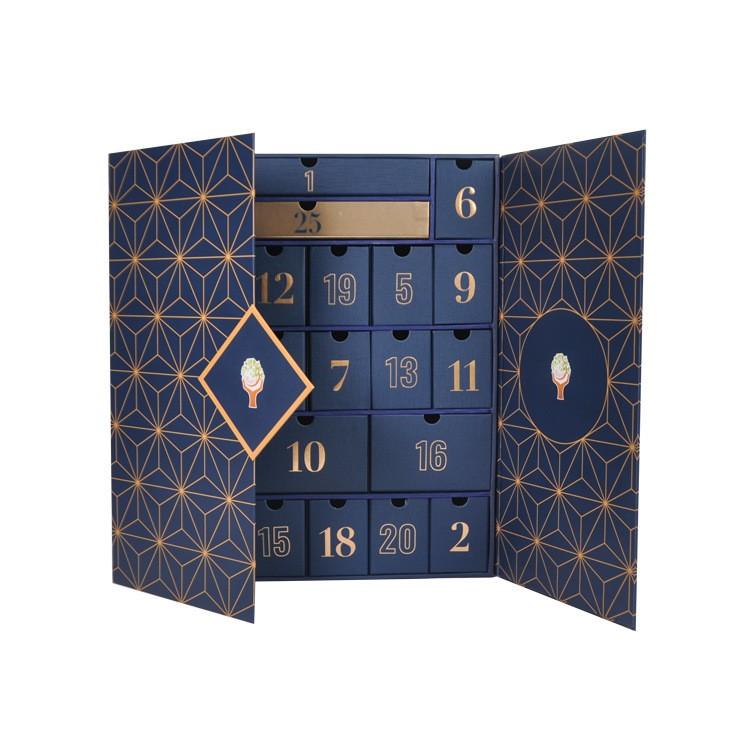
Make Every Product Easy to Remove
Product protection should not come at the expense of usability.
If compartments are too tight, customers may struggle to remove products. If they are too loose, products may move during transportation.
The opening clearance should therefore be considered during structural development.
For example, a tall bottle may require enough space above its cap for customers to lift it out comfortably. A flat product may need a finger-access opening or a suitable lifting feature.
A practical design considers the complete interaction between the customer and the packaging.
This is especially important for countdown boxes because customers repeat the opening experience over 25 days.
5. Custom Printing and Finishing for Luxury Christmas Countdown Boxes
The exterior appearance of a Christmas countdown box plays an important role in how customers perceive the products inside.
For premium brands, packaging is part of the overall product presentation. Color, paper texture, printing quality, and finishing details all contribute to the final impression.
A luxury countdown box does not necessarily need complicated decoration. The right combination of materials and finishing techniques can create a more refined appearance without making the design unnecessarily busy.
Custom Printing for Christmas Packaging
Printing allows brands to create packaging that matches their visual identity and seasonal campaign.
Depending on the project requirements, printing options may include:
Full-color artwork.
Custom brand colors.
Logo printing.
Seasonal illustrations.
Numbered compartment graphics.
Product information and personalized messages.
Artwork should be prepared with the final packaging structure in mind.
For example, the position of a logo on a book-style box may need to align with the opening direction, while graphics on drawer-style packaging should remain visually consistent across the different panels.
Color consistency is also important when multiple packaging components are produced together.
Foil Stamping for a Premium Brand Appearance
Foil stamping can be used to highlight selected design elements such as logos, brand names, borders, and decorative details.
Gold and silver are common choices for luxury Christmas packaging, but other foil colors may also be considered depending on the brand identity.
The technique works particularly well when used selectively rather than covering every available surface.
A carefully positioned metallic logo can create a more refined effect than excessive decorative elements.
Embossing and Debossing
Embossing raises selected areas of the packaging surface, while debossing creates recessed impressions.
These techniques can add texture and visual depth to brand logos, patterns, and decorative elements.
They are often considered when a brand wants its packaging to communicate quality through both appearance and touch.
Lamination and Other Surface Finishes
Surface finishes can influence the appearance and handling characteristics of the outer packaging.
Options may include:
Matte lamination for a softer appearance.
Gloss lamination for a more reflective finish.
Spot UV for selected glossy details.
Textured specialty paper for a distinctive tactile effect.
Other decorative finishes according to the project requirements.
Not every finish is suitable for every paper or structure.
The final selection should consider the artwork, material compatibility, expected handling, and overall budget.
For a Christmas countdown box, it is often better to choose a consistent combination of finishes rather than use too many decorative effects.
6. Custom Christmas Box Manufacturing: From Sample to Mass Production
A successful custom packaging project needs more than an attractive design. The structure, materials, dimensions, and finished appearance must be evaluated before moving into full production.
For a 25-day Christmas box, this is particularly important because the packaging contains multiple compartments and may require several internal components.
A small design error can affect many parts of the finished package.
Step 1: Project Requirements and Packaging Evaluation
The first stage is understanding the customer’s product collection and packaging expectations.
Useful information includes:
Product list and dimensions.
Product weights and packaging formats.
Preferred box structure.
Reference images or design files.
Brand artwork and logo.
Estimated order quantity.
Target delivery date.
If the customer has only an initial concept, structural development can begin with the available reference information.
The purpose is to identify the major packaging requirements before materials and dimensions are finalized.
Step 2: Structural Design and Material Selection
After understanding the project, the structure and material options can be evaluated.
The design should consider the external dimensions, internal compartment arrangement, opening method, and product protection requirements.
Material selection should also reflect the desired appearance and budget.
For premium rigid packaging, paperboard thickness, wrapping paper, and internal construction all influence the final result.
The objective is to develop a structure that can be manufactured consistently rather than creating a design that looks good only in a digital presentation.
Step 3: Sample Development
Sampling allows the customer to evaluate the proposed packaging before mass production.
Depending on the project, sample options may include:
White structural samples.
Structural prototypes.
Printed samples.
Finishing confirmation samples.
Pre-production samples.
Complete packaging assembly samples.
For a 25-day Christmas countdown box, the most useful sample should allow the customer to evaluate the overall structure and actual product fit.
Important checks include:
Are all 25 compartments correctly arranged?
Do the products fit their designated spaces?
Can customers remove the products comfortably?
Does the box open and close as intended?
Are the dimensions suitable for display and shipping?
Does the finished appearance match the approved design?
Any necessary adjustments should be discussed before mass production.
Step 4: Mass Production and Quality Inspection
Once the sample and production requirements have been approved, the project can move into mass production.
LVPACK’s company profile identifies five packaging production lines and a team of 10 quality control personnel.
Quality inspection should consider the requirements of the specific product, including structural dimensions, printing appearance, finishing details, assembly, and packaging condition.
For a multi-compartment countdown box, inspection should pay particular attention to the internal layout and the consistency of the assembled components.
The objective is to ensure that the finished packaging follows the approved sample and project specifications.
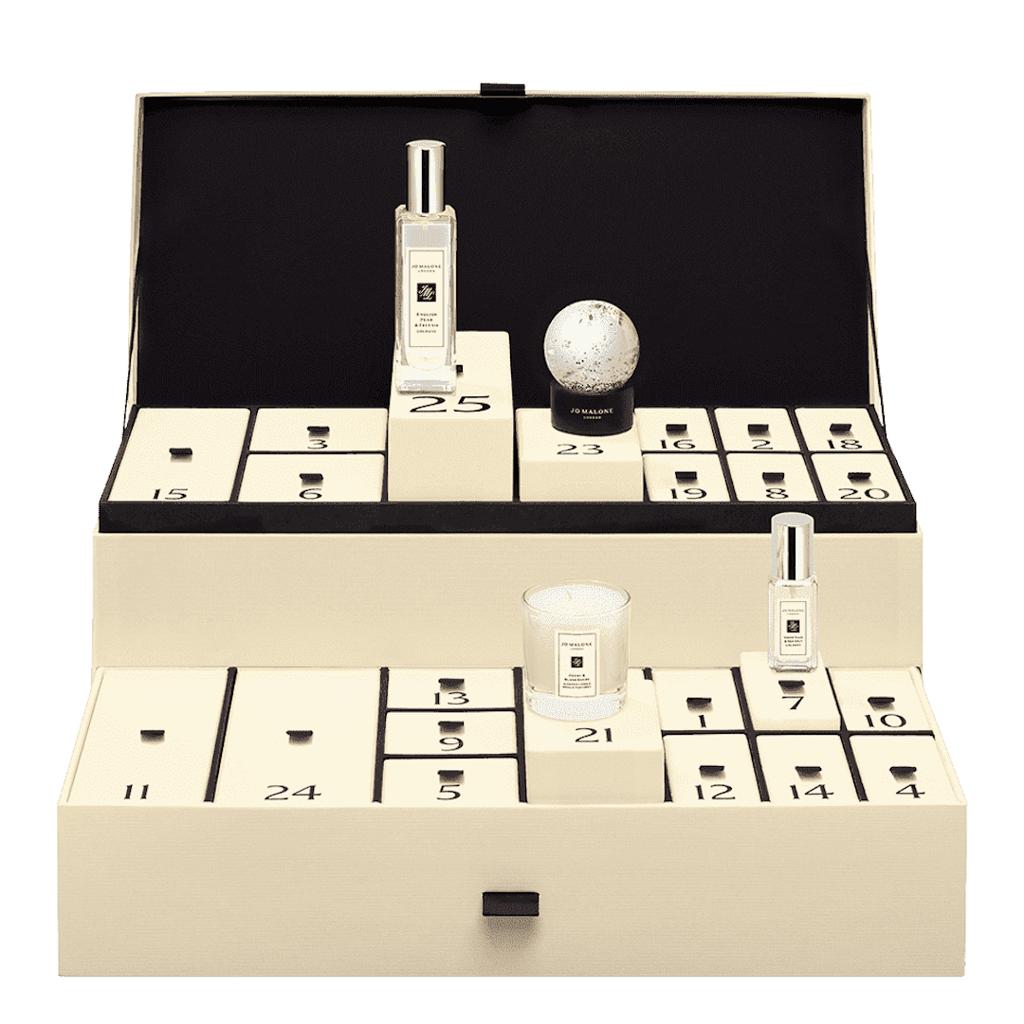
Step 5: Finished Packaging and Delivery Preparation
Before shipment, the completed packaging should be checked and prepared according to the agreed packing requirements.
For international orders, the outer shipping cartons, packing arrangement, and total shipment dimensions should be considered during project planning.
This is especially important for large Christmas countdown boxes, where finished packaging can occupy considerable storage and transportation space.
7. How to Plan Christmas Advent Calendar Box Production and Delivery
Christmas packaging is seasonal. Unlike everyday packaging products, a Christmas countdown box is often tied to a specific retail launch date, promotional campaign, or holiday sales period.
This means the project needs to be planned backward from the date when the finished products must be available.
Waiting until the final weeks before Christmas to begin packaging development can create unnecessary pressure on design approval, material purchasing, production, and international transportation.
Start With Your Target Delivery Date
Before beginning the project, identify when the finished packaging needs to arrive.
For example, a brand planning to launch its Christmas collection in October may need to complete packaging production and international transportation well before the retail launch.
The actual schedule depends on the project complexity, sample approval, material availability, production quantity, and shipping method.
Rather than relying on a generic production estimate, it is better to develop a project-specific schedule.
Allow Enough Time for Sample Approval
Sampling is an important part of the timeline.
A project involving 25 compartments may require adjustments after the first structural sample, especially when products have different dimensions.
Possible adjustments include:
Increasing or reducing compartment sizes.
Changing the internal arrangement.
Adjusting the opening method.
Improving product accessibility.
Modifying the overall box dimensions.
Revising artwork placement.
Each additional sample revision can affect the project schedule.
Providing accurate product dimensions and complete design references at the beginning can help reduce unnecessary changes.
Consider Production and International Shipping Together
Production completion does not mean the project has reached its final destination.
International orders also require time for packing, export arrangements, transportation, and destination handling.
The project schedule should therefore include:
Design confirmation.
Sample development and approval.
Material preparation.
Mass production.
Quality inspection.
Export packing.
International transportation.
Receiving and distribution.
For brands with fixed seasonal launch dates, it is sensible to build a reasonable contingency period into the schedule.
8. Custom 25 Days of Christmas Box Price, MOQ, and Lead Time
The cost of a custom 25 Days of Christmas box depends on more than its external dimensions.
Unlike a simple gift box, a countdown package may contain 25 individual compartments, multiple internal components, and several finishing details. These factors can influence material consumption, structural complexity, assembly requirements, and production time.
Understanding the main cost factors helps brands plan a more realistic packaging budget.
What Determines the Price of a Custom Christmas Countdown Box?
The main pricing factors usually include:
| Cost factor | How it affects the project |
| Box structure | More complex structures may require additional materials and assembly |
| Overall dimensions | Larger boxes generally require more material |
| Number of compartments | Internal dividers and inserts add structural components |
| Insert materials | Different materials have different processing and material costs |
| Printing requirements | Artwork coverage and color requirements influence printing costs |
| Surface finishing | Foil stamping, embossing, and special finishes add processing steps |
| Order quantity | Production volume affects unit cost and material planning |
| Assembly requirements | More complex manual assembly can increase labor costs |
| Shipping dimensions | Finished package size influences transportation expenses |
A simple design with a straightforward internal arrangement will generally have different production requirements from a large luxury countdown box with multiple custom-shaped inserts.
This is why an accurate quotation requires more than the product name or a reference photograph.
What Is the MOQ for Custom 25 Days of Christmas Boxes?
LVPACK’s stated standard minimum order quantity is 1,000 pieces.
The actual suitability of this quantity should be evaluated according to the structure, material requirements, and production arrangements of the specific project.
For brands developing a new Christmas collection, it is useful to estimate the expected sales volume before finalizing the packaging specifications.
A realistic order quantity can help balance the initial packaging investment, unit cost, and available inventory.
How Long Does Custom Christmas Box Production Take?
The production lead time depends on the project requirements.
A straightforward structure may require a different development schedule from a complex 25-compartment package involving multiple samples, custom inserts, and special finishing.
The main factors include:
Structural complexity.
Material availability.
Sample revisions.
Printing and finishing requirements.
Order quantity.
Assembly requirements.
Production scheduling.
The sample development period and mass production period should be considered separately when planning the overall project.
If you have a fixed Christmas launch date, provide the target delivery date as early as possible so that the project schedule can be evaluated before design approval.
What Information Is Needed for an Accurate Quotation?
To evaluate your project, prepare as much of the following information as possible:
Product name and application.
Dimensions of the 25 products.
Preferred box structure or reference image.
Desired materials and finishing options.
Estimated order quantity.
Destination country.
Target delivery date.
If some details are not available yet, an initial product list and reference images can still provide a useful starting point.
9. Why Choose LVPACK as Your Custom 25 Days of Christmas Box Manufacturer?
Choosing a packaging manufacturer is not simply about finding a factory that can produce a box. It is about finding a manufacturing partner that understands the relationship between product requirements, packaging structure, materials, production, and quality.
For a 25-day Christmas countdown box, this relationship becomes particularly important because the finished package contains many individual components that need to work together.
LVPACK, also known as Luxury Vision Packaging Co., Ltd., is a China-based custom packaging manufacturer established in 2013. The company profile states that the team has more than 20 years of packaging industry experience.
Packaging Development Support From Concept to Production
Not every customer begins with a finished packaging design.
Some brands already have detailed drawings and production specifications. Others may only have a product collection, a reference photograph, or an initial creative concept.
LVPACK provides packaging development support covering:
Structural design and development.
Product dimension matching.
Packaging material selection.
Sample development.
Brand logo customization.
Printing and finishing coordination.
Custom insert design.
Mass production.
Quality inspection.
Packaging delivery arrangements.
This development approach is useful for brands that need assistance turning an initial packaging idea into a manufacturable product.
A Dedicated Team and Production Organization
According to the company profile, LVPACK has a total workforce of 80 employees.
The team structure includes:
| Department | Personnel |
| Quality control | 10 |
| Design and sample development | 8 |
| Core production personnel | 50 |
| Printing and post-processing | 6 |
| Project merchandising and order follow-up | 6 |
| Total | 80 |
The company also operates five packaging production lines.
For customers, these resources support different stages of packaging development, production coordination, and quality inspection.
The design and sample development team supports structural and sample-related work, while the quality control team focuses on checking production requirements.
Project merchandising personnel help coordinate customer communication and order follow-up.
Experience Across Different Packaging Categories
LVPACK’s product portfolio covers multiple customized packaging categories, including:
Luxury rigid gift boxes.
Magnetic closure boxes.
Drawer boxes.
Folding gift boxes.
Cosmetic packaging boxes.
Perfume packaging boxes.
Jewelry boxes.
Chocolate and confectionery packaging.
Corporate gift packaging.
Special-shaped packaging.
This range is relevant to Christmas countdown packaging because different product collections may require different structural approaches and internal arrangements.
A beauty advent calendar, for example, has different packaging considerations from a chocolate countdown box or a corporate gift collection.
The packaging structure should be developed around the intended products rather than forcing every project into the same standard design.
A Manufacturing Partner for Different Types of Brands
LVPACK works with different customer groups, including:
Emerging and established beauty brands.
Independent designers and design teams.
E-commerce and DTC brands.
Wholesale buyers and packaging distributors.
Premium and luxury brands.
Corporate gifting businesses.
Packaging procurement companies.
Brand incubation and startup teams.
Whether you are launching a new seasonal collection or developing packaging for an established product range, the project should begin with your actual product requirements.
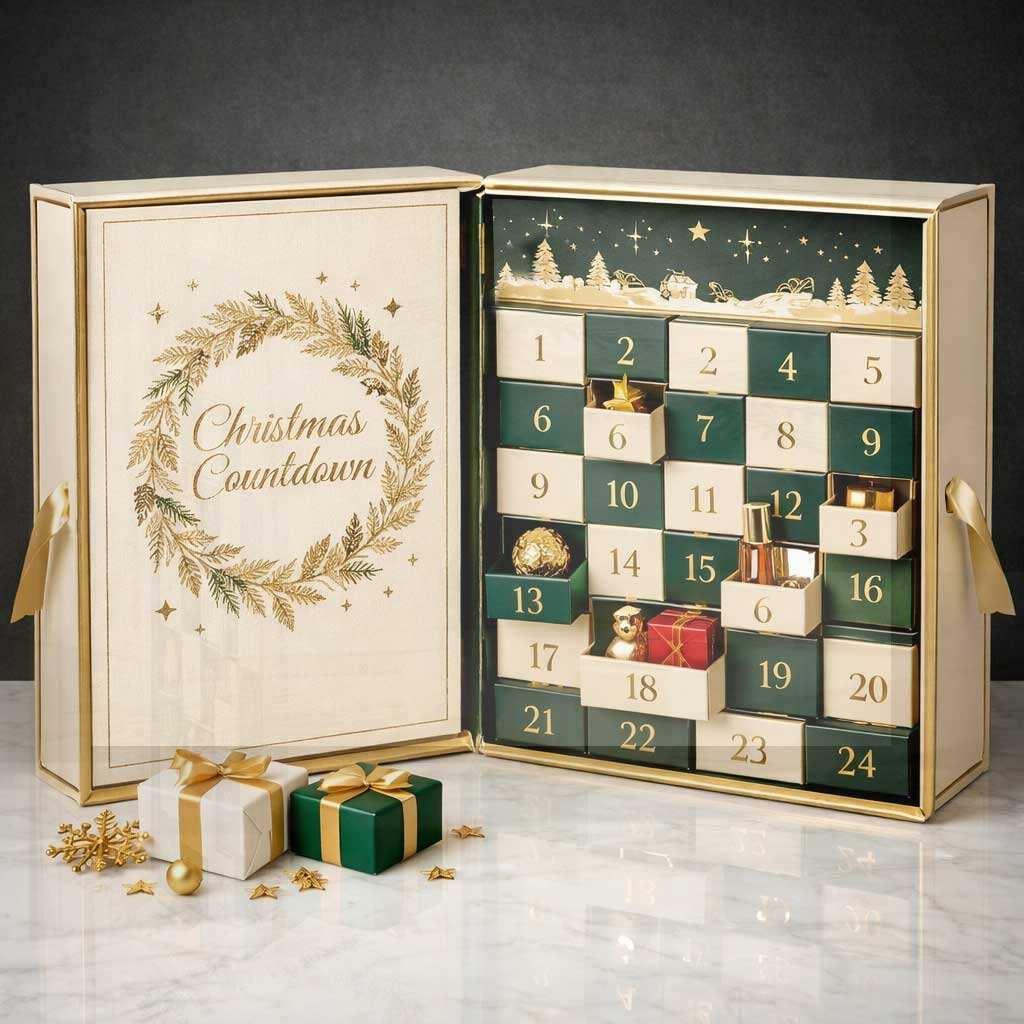
Develop Your Custom 25 Days of Christmas Box With LVPACK
A successful Christmas countdown box brings together product arrangement, structural design, material selection, brand presentation, and manufacturing requirements.
The earlier these elements are considered, the easier it becomes to evaluate the packaging concept and identify potential design issues before production.
If you are planning a custom 25-day Christmas advent calendar, LVPACK welcomes your project requirements.
To begin, share:
Your product list and dimensions.
Reference images or design files.
Preferred box structure.
Estimated order quantity.
Target delivery date.
Any specific material or finishing preferences.
Our team can review the information and discuss suitable packaging development and production options for your project.
Contact LVPACK to discuss your custom 25 Days of Christmas box project and develop packaging that brings your brand’s holiday collection to life.