Custom Calendar Box Manufacturer | Premium Calendar Packaging Solutions

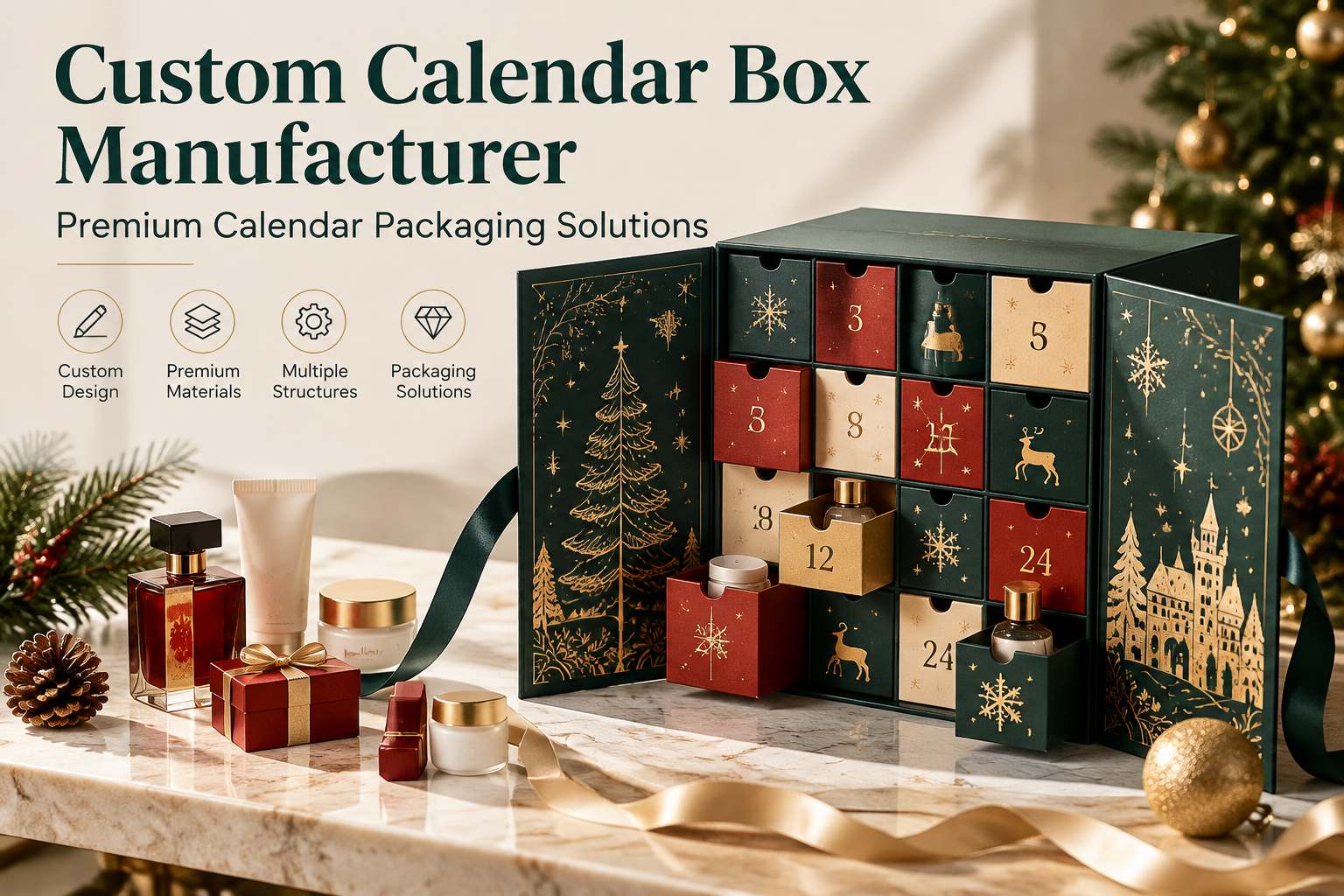
Custom Calendar Box Manufacturer for Seasonal and Premium Product Packaging
A calendar box has a very different job from an ordinary folding carton or gift box. It needs to organize multiple products, create a clear opening sequence, protect individual items, and still look attractive enough to become part of the customer’s experience. For seasonal collections, beauty products, confectionery, gifts, and promotional sets, the packaging can influence how the entire product is perceived.
The challenge is that a calendar box is essentially a packaging system rather than a single box. The number and size of compartments affect the internal structure. The products determine the insert design. The outer dimensions influence material usage, shipping volume, and production cost. Printing and finishing then need to support the brand without making the structure unnecessarily complicated.
A successful custom calendar box is therefore developed by balancing product fit, structure, presentation, protection, production feasibility, and cost. The right solution is not always the largest or most decorative box. It is the one that works reliably from the first sample through mass production.
1. What Can a Custom Calendar Box Do for Your Product and Brand?
A calendar box can turn a collection of individual products into one coordinated product experience. Instead of opening one package once, customers interact with different compartments over a period of time or according to a planned sequence. This makes the packaging part of the product story.
For seasonal collections, the format can create anticipation while giving brands more space to communicate colors, graphics, product information, and seasonal themes.
A well-designed calendar package can:
Present multiple SKUs as one coordinated collection.
Create a structured unboxing experience rather than a single product reveal.
Strengthen seasonal branding through graphics and finishing.
Increase perceived value by presenting several products as one premium set.
Protect individual products with appropriately designed internal compartments.
Support promotional campaigns and limited-edition product launches.
Calendar packaging can also work alongside other packaging formats such as Custom Gift Boxes, Cosmetic Boxes, Perfume Boxes, Chocolate Boxes, and Candle Boxes when a brand sells several related product lines.
Why Product Dimensions Come First
One of the most important decisions is the relationship between the product and each compartment.
A common mistake is to select an attractive outer box first and then try to fit the products inside it. This can lead to oversized compartments, poor product stability, difficult removal, or unnecessary material and shipping costs.
A better approach starts with:
Product dimensions → compartment layout → insert structure → outer box dimensions
The design should consider:
Product length, width, and height
Product shape and weight
Number of products
Number of compartments
Clearance for removing each item
Insert thickness
Internal dividers
Protection requirements
Finished box dimensions
Shipping volume
A few millimeters can matter when many compartments are combined into one structure. The internal layout should therefore be developed around the actual products rather than a generic calendar template.
2. Which Custom Calendar Box Structure Fits Your Product?
There is no single best calendar box structure for every product. The right choice depends on the number of compartments, product dimensions, opening method, target price, presentation requirements, and shipping conditions.
Common structures include:
| Structure | Typical Use | Main Consideration |
| Drawer-style | Premium collections and gifts | Strong presentation and controlled opening |
| Magnetic closure | Luxury seasonal sets | Premium feel and reusable structure |
| Door-opening | Advent-style products | Clear visual presentation |
| Foldable structure | Efficient storage and shipping | Requires careful structural development |
| Multi-layer structure | Collections with different product sizes | More complex assembly |
| Custom compartment layout | Mixed-SKU collections | Designed around individual products |
A drawer-style calendar box can provide a smooth opening experience and a strong premium impression. Magnetic structures can add a more substantial feel, but magnets also introduce additional material and assembly considerations.
Door-opening formats are often useful when the customer needs to see a clear sequence of numbered compartments. Foldable structures may help reduce shipping volume, but the folding points and internal support need to be tested carefully.
The best structure should be selected according to the complete project rather than appearance alone.
Structure Should Match the Customer Experience
Ask how the customer will actually use the box.
Will one compartment be opened each day? Will the entire collection be opened at once? Does the customer need to remove small products individually? Will the package be kept after the products are used?
These questions can change the structure significantly.
For a premium seasonal collection, the opening experience may be almost as important as the products themselves. For a promotional calendar designed for large-volume distribution, simple assembly and efficient shipping may be more important.
This is why calendar packaging should be treated as a combination of structural engineering and product presentation.
3. How Should Calendar Box Inserts and Compartments Be Designed?
The internal structure is one of the most important parts of calendar packaging because it directly controls product fit, protection, filling efficiency, and customer experience.
The outer box may receive most of the visual attention, but poorly designed compartments can quickly undermine the finished product.
A suitable Custom Box Insert should keep each product in position while providing enough clearance for easy removal. It also needs to work with the manufacturing and assembly process.
Key Insert Considerations
Product dimensions and tolerances
Number of compartments
Different product sizes
Product weight
Required protection level
Insert material thickness
Compartment depth
Product removal method
Manual or automated filling
Transportation conditions
A collection with identical products can often use a regular grid. A mixed collection may require different compartment sizes, shaped cavities, dividers, or layered inserts.
For fragile products, the insert may need additional support around the product. For lightweight items, excessive protection can create unnecessary cost and volume.
12, 24 or 25 Compartments?
Twenty-four compartments are common for advent-style calendars, but the format does not have to be fixed.
12 compartments can suit shorter campaigns or smaller collections.
24 compartments are widely associated with advent-style calendars.
25 compartments can extend the sequence through Christmas Day.
Custom compartment counts can be developed for promotional campaigns.
Mixed-size layouts can accommodate products with different dimensions.
The compartment count should follow the actual product collection rather than being selected simply because a particular number is familiar.
For example, 24 products with similar dimensions may fit efficiently into a regular layout. A collection containing bottles, jars, boxes, and accessories may benefit from an irregular arrangement that gives each product enough space.
4. Which Materials, Printing and Finishing Options Work for Calendar Packaging?
Material selection affects more than appearance. It influences structural strength, folding performance, surface quality, printing results, assembly, shipping weight, and overall cost.
Paperboard and rigid board are common choices for premium calendar packaging, while the final material specification depends on the structure and product requirements.
Typical options may include:
Paperboard
Rigid paperboard
Coated paper
Specialty textured paper
Recycled or recyclable paper materials
Laminated board structures
The external surface can then be customized using different printing and finishing techniques.
Printing Options
Depending on the artwork and production requirements, common printing methods include:
Offset printing
Digital printing for suitable short-run applications
CMYK color printing
Pantone color matching
Custom graphic printing
Surface Finishing
Finishing options can include:
Foil stamping
Embossing and debossing
Spot UV
Matte or gloss lamination
Soft-touch lamination
Textured paper surfaces
The important question is not how many finishing techniques can be added. It is which techniques actually support the brand concept.
For example, a minimal luxury design may only need a refined paper surface and a small foil logo. A highly decorative seasonal collection may use multiple colors, patterns, foil details, and embossing.
Using too many effects can increase production complexity without necessarily improving the customer’s experience.
The strongest result usually comes from selecting materials and finishing together with the structure, rather than treating decoration as the final step.
5. How Does a Custom Calendar Box Go From Concept to Sample?
Calendar packaging requires more coordination than a standard single-compartment box because several dimensions and components need to work together.
A practical development process can be divided into several stages.
Step 1: Product and Project Review
The project starts with the basic requirements:
Product dimensions
Product quantity
Number of compartments
Reference images or artwork
Target order quantity
Desired materials
Target launch date
Shipping requirements
Step 2: Structural Development
The outer structure and internal compartment layout are developed together.
This stage determines the opening method, compartment arrangement, insert design, folding lines, dimensions, and material requirements.
Step 3: Prototype and Sample
A physical sample helps verify whether the concept works in reality.
The sample should be checked for:
Product fit
Compartment dimensions
Opening and closing
Insert stability
Visual proportions
Logo placement
Structural strength
Assembly practicality
A sample that looks good but is difficult to assemble or fill is not yet a finished packaging solution.
Step 4: Artwork and Finishing Confirmation
After the structure is confirmed, artwork and finishing specifications can be finalized.
Color, logo position, foil details, embossing, surface treatment, and other decorative elements should be checked against the actual structure.
Step 5: Production Preparation
Before mass production, material specifications, production drawings, artwork, assembly requirements, and quality standards need to be aligned.
This process helps reduce avoidable changes between the approved sample and production batch.
6. What Should Buyers Know About MOQ, Lead Time and Quality Control?
MOQ and lead time depend on the actual calendar box structure, material selection, order quantity, finishing requirements, assembly complexity, and production schedule.
For that reason, a single universal lead time or MOQ is not appropriate for every project.
The production plan should instead consider the complete workflow:
Material preparation → printing → finishing → cutting → forming → insert production → assembly → inspection → packing
Calendar packaging can contain many small components, so consistency becomes particularly important during mass production.
What Should Quality Control Check?
A practical quality inspection should focus on the parts that customers will see and use.
Key checkpoints include:
Overall box dimensions
Structural alignment
Compartment dimensions
Insert fit
Opening and closing performance
Surface scratches and dents
Printing consistency
Color consistency
Foil and embossing quality
Glue and assembly quality
Product stability inside compartments
Packing condition before shipment
The approved sample should serve as an important reference for production consistency.
This is particularly important for seasonal packaging because a production delay can affect the entire retail campaign. Quality problems discovered shortly before launch are much harder to correct than issues identified during sampling.
7. What Determines Custom Calendar Box Price and Total Project Cost?
The price of a calendar box is not determined by box size alone.
A more useful way to understand cost is to look at the components that create it.
| Cost Factor | Potential Impact |
| Box dimensions | Affects material usage |
| Number of compartments | Influences structure and assembly |
| Insert design | Adds material and production complexity |
| Material specification | Changes strength, appearance, and cost |
| Printing | Depends on artwork and color requirements |
| Finishing | Adds process and material costs |
| Magnets or hardware | Adds component and assembly costs |
| Order quantity | Influences unit economics |
| Assembly | Can become significant for complex structures |
| Packing and shipping | Affected by finished volume and weight |
A more complicated calendar box does not automatically provide better value.
For example, adding several finishing processes may improve appearance but have little effect on the actual customer experience. Similarly, reducing material thickness may lower unit cost but create problems with structural stability.
The better approach is to optimize the total project cost, not simply the factory unit price.
For buyers comparing packaging suppliers, it is useful to consider:
Unit price
Sampling cost
Tooling or development cost
Assembly requirements
Packaging volume
Shipping cost
Expected defect rate
Production lead time
Communication efficiency
A slightly higher unit price may still produce a lower overall project cost if the packaging requires fewer revisions, has better assembly efficiency, and arrives consistently.
8. How Can You Start a Custom Calendar Box Project?
A calendar box project does not need to begin with a finished design. Many brands start with a product list, reference image, rough concept, or simple dimensional drawing.
The most useful information to provide includes:
| Information to Prepare | Example |
| Product type | Cosmetics, chocolate, gifts, candles, accessories |
| Product dimensions | Length × width × height |
| Number of products | 12, 24, 25, or custom quantity |
| Compartment requirements | Equal or mixed sizes |
| Box style | Drawer, magnetic, door-opening, foldable |
| Material preference | Paperboard, rigid board, specialty paper |
| Artwork | Existing design or reference concept |
| Order quantity | Estimated production volume |
| Launch date | Target delivery schedule |
| Shipping destination | Helps evaluate packing requirements |
From there, the packaging can be developed around the actual products and commercial requirements.
For brands that need related packaging for a broader product collection, Luxury Packaging Boxes and Custom Packaging Boxes can also be developed as part of a consistent packaging system.
The goal is not simply to manufacture a box. It is to create a calendar packaging structure that fits the products, works during assembly, survives transportation, communicates the brand, and delivers the intended customer experience.
If you already have product dimensions, reference artwork, compartment requirements, or an existing packaging concept, those details provide a practical starting point for developing the right calendar box structure and sample.
Add a stronger buyer-focused call to actionAdd clear calendar box specifications